Sankhya
Kārikā
The philosophy of yoga — verse by verse with Dr. H.V. Nagaraj Rao
The theory behind the practice
Every practitioner of yoga eventually encounters Sankhya — the ancient Indian philosophical system that provides the conceptual architecture for the Yoga Sūtras, the Bhagavad Gītā, and virtually every other foundational text in the tradition. Its vocabulary runs through everything: puruṣa and prakṛti, the three guṇas, buddhi, ahaṃkāra, the five tanmātras. When Patañjali describes the nature of the mind or Kṛṣṇa explains liberation, they are drawing on a framework Sankhya built.
Sankhya and Yoga are two sides of the same coin. Sankhya is the theory — a complete, rational, systematic account of what reality is, how suffering arises, and what liberation means. Yoga is its practical application. You cannot fully understand one without the other.
Studying Sankhya does not add something new to your practice — it reveals the structure of what was already there. This course offers that foundation, taught verse by verse through the Sankhya Kārikā of Īśvarakṛṣṇa — the classical text of the tradition — by a scholar who has spent a lifetime inside the philosophical world these verses inhabit.
What Sankhya actually teaches
The word Sankhya means enumeration — a precise, systematic account of reality. The tradition identifies 25 fundamental principles (tattvas) that together constitute everything that exists: from the original undifferentiated matter (prakṛti) through its evolutes — intellect, ego, mind, senses, elements — to the pure unchanging consciousness (puruṣa) that witnesses it all.
Suffering arises from the confusion of puruṣa (the witnessing soul) with prakṛti (ever-changing nature governed by the three guṇas). Liberation comes from discriminating clearly between the two.
Twenty-five evolving principles, three reliable means of knowledge — perception, inference, and trustworthy testimony — and a precise anatomy of mind, senses, and vital energies, all oriented toward self-realisation.
Each individual soul is many and eternal, carrying a subtle body with karmic tendencies across lifetimes, yet remaining untouched and free at its core. The soul is the silent witness, never the actor.
Liberation begins with training buddhi (intellect) to turn inward, detach from the play of the guṇas, and rest in the silent clarity of puruṣa — transforming everyday experience into a path of insight.
Sankhya is wholly rational and logical. There is no mention of any deity. It simply lays out a precise worldview that enables the practitioner to understand the nature of experience and transcend unnecessary suffering. It is, in the deepest sense, the philosophy of yoga.
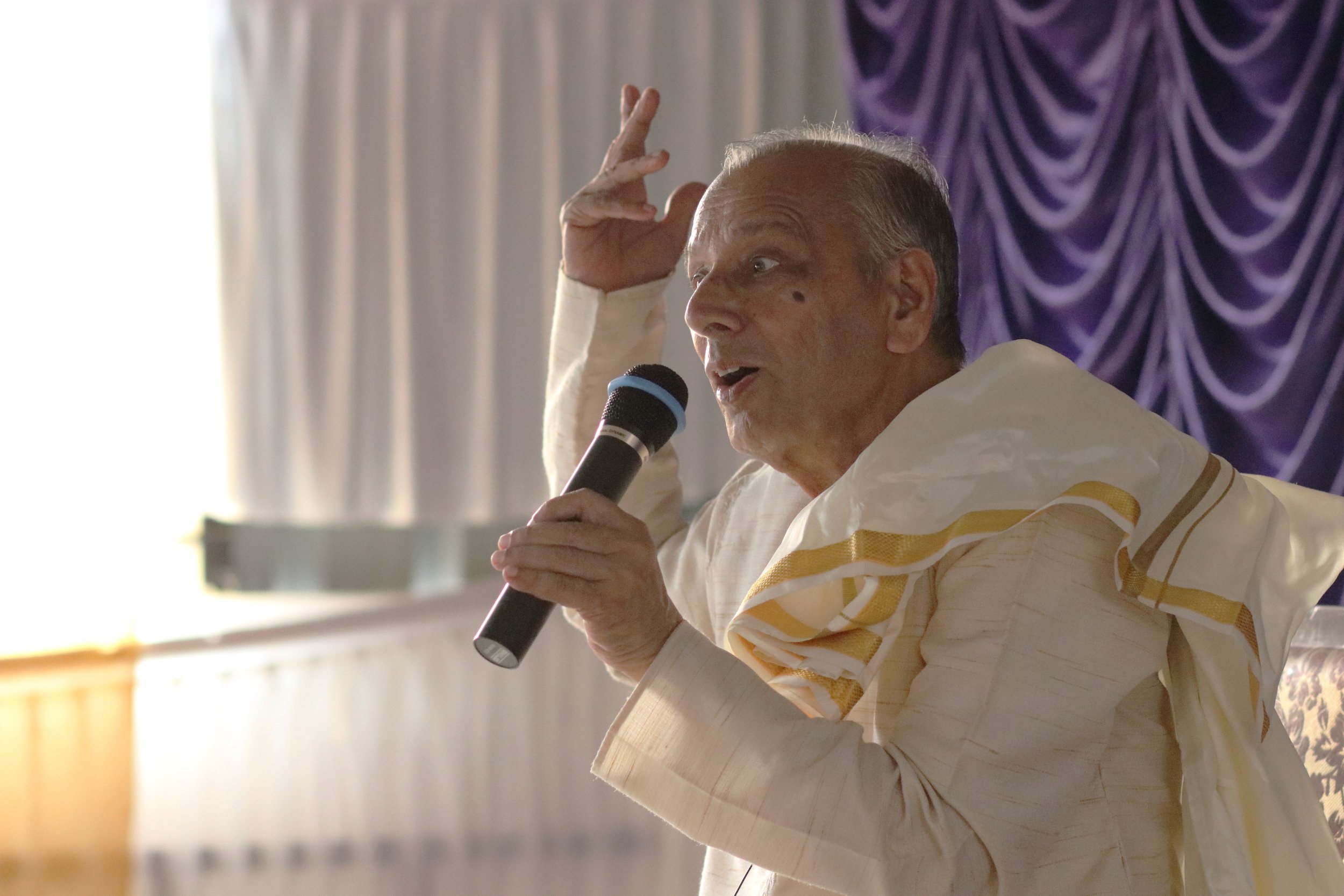
Dr. Rao’s speciality is Vyākaraṇa and Alaṅkāra — Sanskrit grammar and poetics. He can speak with precision about exactly what is meant by any Sanskrit text. In a lifetime of scholarship he has published original Sanskrit works with English and Kannada translations, and lectured across four continents.
What sets Dr. Rao apart is his uncanny ability to illuminate technically dense philosophical texts with clarity, precision, and genuine warmth. Students who have spent years reading about Sankhya consistently remark that its concepts became genuinely clear for the first time under his teaching. At 84, he continues his lifelong passion for sharing ancient Indian knowledge with students from around the world.
Dr. Rao teaches from within the Mysore Sanskrit community — the same tradition that produced Śrī Kṛṣṇamācārya. His understanding of Sankhya is not assembled from secondary literature. It is the living understanding of a scholar formed inside the tradition these texts belong to.
What the course covers
The course works through the Sankhya Kārikā of Īśvarakṛṣṇa — the foundational text of classical Sankhya, composed in 72 verses. Dr. Rao takes each verse carefully, explaining its Sanskrit terminology, its philosophical argument, and its relevance to yoga practice and daily life.
Name and explain Sankhya’s 25 core principles (tattvas) in plain language — from prakṛti through its evolutes to puruṣa.
Understand how the three guṇas — sattva, rajas, and tamas — shape every aspect of experience, and learn to work with them purposefully.
Distinguish the witness (puruṣa) from the constantly changing activity of mind, body, and experience — the central discriminative insight Sankhya cultivates.
Gain a foundational understanding that directly illuminates the Yoga Sūtras, the Bhagavad Gītā, and most other classical Indian texts — Sankhya is the shared vocabulary of the tradition.
What is included
Complete verse-by-verse recordings with Dr. Rao — stream on any device, revisit anytime.
Every session as audio only — Sankhya is well suited to contemplative listening.
A written summary of each lesson to read before or after watching.
A downloadable copy of the original Sankhya Kārikā for reference throughout your study.
A 30-minute session with Andrew Eppler to clarify concepts or integrate them into your practice — included in the price.
Your course never expires. Sankhya deepens with return visits as your practice matures.
Certificate of completion issued by Saṃskṛti Foundation, Mysore.
Recognised as Continuing Education for Yoga Alliance registered teachers.
Who this course is for
This course is for anyone who wants to understand the philosophical foundations of yoga at a deeper level than most trainings reach. You do not need to read Sanskrit. You do not need any background in Indian philosophy. The course is designed to be entered from wherever you are.
It is particularly suited to yoga teachers and practitioners who find the Yoga Sūtras or Bhagavad Gītā fascinating but feel they are missing the conceptual vocabulary to fully grasp them. Sankhya is that vocabulary — once you have it, everything else becomes clearer.
It is also an excellent course for meditators seeking a rational map of mind and liberation, and for therapists or coaches who are drawn to India’s ancient understanding of consciousness and suffering.
No prior Sanskrit or philosophy is required. What is required is genuine curiosity and the willingness to think carefully about the nature of experience.
Sankhya and the Mysore lineage
Śrī Kṛṣṇamācārya’s yoga was rooted in the full breadth of Indian philosophical learning — and Sankhya was central to that formation. The Yoga Sūtras themselves presuppose Sankhya’s metaphysical framework: Patañjali’s puruṣa, prakṛti, guṇas, and citta are all Sankhya categories, deployed within a yogic practice context.
To study Sankhya with Dr. Rao — a scholar formed within the Mysore Sanskrit community that produced Śrī Kṛṣṇamācārya — is to encounter these ideas as they were understood within the tradition that gave birth to modern yoga. Not as academic curiosities, but as a living map of the mind and the path to freedom.
Enroll today
Start learning immediately. Your course never expires.
Questions first? Reach out directly — I’m happy to help.
Andrew Eppler · andrew@ashtangayogastudio.com
WhatsApp +1 (405) 503-7779
If the course fee presents a genuine difficulty, please reach out. We will find a way.

The Sankhya Kārikā, the Yoga Sūtras of Patañjali, and the Bhagavad Gītā form the three courses of the Yoga Trilogy — the philosophical and practical foundations of yoga as Mysore’s tradition has always taught them. Sankhya is the ground. The Sūtras are its practice. The Gītā is its living expression. Studied together, they become something rare: a complete philosophical education in the tradition that gave modern yoga to the world. All three courses include video, audio, and written notes with permanent access.
Save $66 by studying the complete Yoga Trilogy. Explore the Trilogy →