Mysore Yoga Traditions
The Origins of Mysore Yoga
A living spiritual lineage behind the yoga the world practices.
॥ śrīḥ ॥
This account of the Mysore Yoga Tradition is offered in loving memory of
Śrī U.Ve. Prof. M.A. Lakṣmīthāthāchārya Swami
26 August 1936 – 15 May 2021
without whose life, scholarship, and generosity none of this would be known to us.
May it be received in the spirit in which it was given.
A Brief Introduction
Much of the yoga practised around the world came from Mysore. When something has changed our lives as this practice has, it is only natural to want to know where it came from. I have been studying the cultural history of this city for some years now, and I would like to share a little of what I have learned.
I will start by saying that if we go looking for a simple ancient pedigree behind a particular āsana practice, the history may prove more complicated than we expect. At least as far as my own studies have revealed, it is simply not that straightforward.
What can be said is that Mysore has an extraordinarily rich history, and that it is truly an honour to have learned yoga from such a remarkable community. The longer I study, the more astonished I become at how many layers and facets there are.
Mysore is a city of many traditions: Vaiṣṇava, Śaiva, and Śākta; Advaita, Viśiṣṭādvaita, and Dvaita; families, maṭhas, temples, and colleges that have been teaching, reciting, debating, and worshipping alongside one another for centuries, within a culture of learning long supported by the Mysore court. No single account could contain that world, and this one does not try.
What follows traces one of the living threads within it: a Śrīvaiṣṇava paramparā descended from Rāmānuja through Ananthāchārya. It has been opened to me by one of my most revered teachers, Śrī U.Ve. Prof. M.A. Lakṣmīthāthāchārya Swami, and by his son, my teacher Dr. M.A. Alwar. Much of what is shared here comes through their family's history, scholarship, memory, and living transmission. To be allowed even a glimpse into that world is something I regard with deep gratitude.
Śrī Kṛṣṇamācārya also came from the Śrīvaiṣṇava world, a tradition with many branches, houses, and centres of learning, shaped by his own family inheritance, his own teachers and institutions, and his own course of study. His formation is a story worth telling carefully, and best told by those who hold it. What this page offers is one window, and through it something of the wider atmosphere of Mysore begins to come into view: a city where Vedānta, Sanskrit scholarship, devotional practice, temple culture, royal patronage, and yoga lived in continual proximity.
This account reflects my ongoing study, still deepening the longer I sit with it. Whatever depth and truth you find here belongs to the tradition and to the teachers who shared it; any shortcoming is mine alone. It is offered with gratitude, and in the spirit the tradition itself keeps: the door is open to all who sincerely seek.
The Śrīvaiṣṇava Community
Iyengars are a community of Tamil Brāhmaṇas found across South India and throughout the world. They worship Śrīman Nārāyaṇa and follow the teachings of the philosopher-ācārya Rāmānuja, whose system is called Ubhaya Vedānta, a tradition that gives equal weight to the Sanskrit Vedas and the Tamil Divya Prabandham of the Āḻvārs.
The word Iyengar is the anglicised form of the Tamil Aiyaṅkār, meaning "those entrusted with the five duties." These five duties refer to the Pañca Saṃskāra, the five rites of initiation conferred by an ācārya of the Śrīvaiṣṇava paramparā. The rites are personal and not named here. The word long predates its association with any yoga style, and refers specifically to this community of initiated Śrīvaiṣṇavas and the tradition they carry.
All Iyengars trace their ancestry to one of the seventy-four siṃhāsanādhipati, the principal disciples appointed by Rāmānuja himself to carry his teaching forward. The Māṇḍyam Śrīvaiṣṇava Iyengars trace their line specifically to Ananthāchārya, who lived in an agrahāra called Māṇḍyam in Karnataka before travelling to Śrīraṅgam to study under Rāmānuja.
After completing his studies, Ananthāchārya was sent by Rāmānuja to Tirumala, where he settled and performed the daily puṣpa kaiṅkarya, the offering of flowers, to Lord Veṅkaṭeśvara. His descendants continued to live in four villages near Tirumala, all named in memory of the original Māṇḍyam in Karnataka: Ilaiya Māṇḍyam (also known as Bālamāṇḍyam, four kilometres from Tiruchhānūr, built according to Ananthāchārya's own instructions), Gajalu Māṇḍyam, Tirumāṇḍyam, and Chinnamāṇḍyam. The word Māṇḍyam itself is of ancient origin and is inextricably linked to Ananthāchārya's name.
In the fourteenth century, a descendant of Ananthāchārya, Periya Govindarāja Wodevar, settled at Śrīraṅgapaṭṭana as Rāja Guru to the king. Later, Cikka Govindarāja Wodevar, after defeating a Vīraśaiva scholar in a famous debate before King Kṛṣṇadevarāya, was granted six villages in the present Mandya District. He moved there with Śrīvaiṣṇavas of thirteen gotra, naming the new settlement Māṇḍyam in memory of Ananthāchārya's original village in Karnataka. The Māṇḍyam Śrīvaiṣṇava community came into being from this moment.
The Spiritual Lineage
The Śrīvaiṣṇava tradition holds that its philosophical transmission begins not with a human teacher but with Śrīman Nārāyaṇa himself, descending through a line of ācāryas whose realisation of Viśiṣṭādvaita, qualified non-dualism, was direct and unmediated. The Āḻvārs, the poet-saints of South India, experienced these truths before they were formulated as philosophy. Their outpourings in Tamil, gathered as the Divya Prabandham, together with the Sanskrit Vedānta, constitute the Ubhaya Vedānta, the twin canon of Śrīvaiṣṇavism.
The descent of this teaching is recorded as follows:
From Rāmānuja descends the particular Ācārya Puruṣa Paramparā to which this document is devoted:
Nāthamuni
c. 823 CE · Vīranārāyaṇapuram, Tamil Nadu
Nāthamuni stands near the headwaters of this tradition, and near the root of Śrī Kṛṣṇamācārya's own lineage. Born c. 823 CE in Vīranārāyaṇapuram (present-day Kattumannarkoil, near Chidambaram), and known from birth as Araṅganātha, he became a Śrīvaiṣṇava ācārya of exceptional learning and spiritual power. He is credited with recovering the Divya Prabandham, the four thousand Tamil verses of the Āḻvārs, after they had been lost for generations. He systematised them, set them to music, and established the tradition of their recitation alongside the Sanskrit Vedas: the very foundation of Ubhaya Vedānta.
His encounter with his own teacher, Nammāḻvār, came not in person but in vision. Meditating beneath an ancient tamarind tree at Āḻvār Tirunagari, on the banks of the Tāmraparṇī, Nāthamuni received the lost teachings that became the Yoga Rahasya.
Centuries later, Śrī Kṛṣṇamācārya, a direct descendant of Nāthamuni, made a pilgrimage to that same tree at Āḻvār Tirunagari at the age of sixteen. In a mango grove near the ancient shrine, he collapsed in exhaustion, and in that state encountered his ancestor, who chanted to him the verses of the Yoga Rahasya, the same text that had been lost for more than a thousand years. Śrī Kṛṣṇamācārya memorised those verses and later transcribed them; they became one of the foundational references of his teaching.
Whether one receives this as visionary transmission or understands it as the way Śrī Kṛṣṇamācārya honoured and attributed his own inspiration, what is clear is that he never claimed originality. Everything he taught, he traced back to the ancient lineage, and to Nāthamuni above all. The place of transmission was the same. The ancestor was the same. The teaching flowed in the same direction it always had: from guru to śiṣya, across time, through the unbroken thread of paramparā.
Rāmānujāchārya
1017 – 1137 CE
Among the great ācāryas of the Śrīvaiṣṇava tradition, Rāmānuja stands resplendent and singular. He inherited a lineage of deep devotion and rigorous philosophy, systematised it into the school of Viśiṣṭādvaita, qualified non-dualism, and then, crucially, gave it away. He was prepared to sacrifice his own liberation for the liberation of all beings, and was hailed as Kṛpāmātra Prasannāchārya, the ācārya pleased by compassion alone.
He was also a social reformer of rare conviction, drawing all people, regardless of caste, creed, or sex, under the banner of bhakti and prapatti: devotion and self-surrender. In the tradition he established, even Śrīman Nārāyaṇa could not retrieve a soul lost in the ocean of transmigration without the compassionate intercession of Lakṣmī. He accorded the Āḻvār poet Āṇḍāḷ the highest spiritual status, continuously reciting her Tiruppāvai as containing the essence of all the Vedas, both Sanskrit and Tamil.
Among thousands of disciples, Rāmānuja chose seventy-four to be siṃhāsanādhipati, those alone, in his judgement, capable of carrying the tradition forward. Of those seventy-four lines, almost all have ceased to function as Svayam Ācārya Puruṣa Paramparā, the unbroken, self-sustaining lineages in which the spiritual succession descends within the line itself, without recourse to an external monastic seat.
The line of Ananthāchārya, known as the Ānandāṅpiḷḷai Paramparā, alone survived. And even within that line, branches arose (the Manikarṇika, Rāmānujapuram, Appalāchārya, and Ayyapaṭṭai lines among them), of which only one has continued in unbroken transmission as a Svayam Ācārya Puruṣa Paramparā to the present day: the line of the Māṇḍyam Ānandāṅpiḷḷais. It is this line that is the subject of this account.
Ananthāchārya
Born 1053 CE · Siruputtūr (now called Kirangūr), on the banks of the Kāverī
Son of Keśavāchārya of the Bhāradvāja gotra. After early studies under his father, Ananthāchārya travelled to Śrīraṅgam and came to study Viśiṣṭādvaita at the feet of Rāmānuja himself. He arrived accompanied by several other scholars from Karnataka, including Choṭṭai Nambi, Maradur Nambi, and Tondanūr Nambi. But it was Ananthāchārya whose genius distinguished him, and it was Rāmānuja who saw it and drew him forward.
Among all the siṃhāsanādhipati, Ananthāchārya is peerless, and the moment that proved it is recorded with precision. During a discourse on Nammāḻvār's Tiruvāymoḻi, Rāmānuja expressed the wish that someone go to Tirupati to perform the puṣpa kaiṅkarya, the daily offering of flowers, to Lord Śrīnivāsa. It was a mission that meant physical hardship, the dangers of the wild forests of Tirumala, and above all separation from the presence of the ācārya himself. Among hundreds of disciples, only Ananthāchārya stepped forward.
"You are the only āṇpiḷḷai, the only true man, in this assembled gathering. You have shown your manliness by daring to go to Tirumala, surrounded by thick forests and wild creatures, in chilly weather, accepting separation from me."
The full Tamil form is Aananthān Āṇpiḷḷai. From that day, Ananthāchārya bore the name Ānandāṅpiḷḷai. All his descendants carry it still.
At Tirumala, working entirely alone, Ananthāchārya dug a tank he named Rāmānuja Putrerī, grew a vast garden of fragrant flowers from its waters, and from those flowers performed the daily puṣpa kaiṅkarya of Lord Śrīnivāsa without interruption. Tirumala in its entirety came to be regarded as a puṣpa maṇṭapa, a pavilion of flowers, because Lord Veṅkaṭeśvara, residing there, alone enjoys their fragrance all around.
The tradition preserves a number of devotional incidents, told and retold in the community, that show the closeness of Ananthāchārya's relationship with the divine, and the absolute precedence he gave to his ācārya's command over every other consideration.
The crowbar at the Tirupati temple
While digging the irrigation tank for his flower garden, Ananthāchārya was approached by a brahmacāri, a young Brahmin student, who offered to help with the work. Ananthāchārya refused; the kaiṅkarya, the service personally commanded by Rāmānuja, was his alone to perform. When the young man persisted, Ananthāchārya, in his fierce devotion to his ācārya's command, hurled the crowbar he was using and struck the visitor.
The young Brahmin, it turned out, was Lord Śrīnivāsa himself, in disguise.
The crowbar is kept to this day at the entrance to the Tirupati temple, and camphor is applied daily to the place of the wound on the Lord's image. Both are preserved by the community as visible memories of the incident.
Goddess Lakṣmī and the naming of the Lakṣmīthāthāchārya line
Ananthāchārya allowed no one into the flower garden he had created for the Lord's worship. But the Lord himself began to visit it secretly at night, plucking flowers and breaking branches. Unable to catch the intruder, Ananthāchārya kept watch one night, and saw Lord Veṅkaṭeśvara and his consort Padmāvatī disguised as a royal couple. He gave chase. The Princess was caught and bound to a tree; the Prince escaped.
When the temple was opened the next morning, the priests were horrified to find the Lord's chest bare, without the figure of Goddess Lakṣmī in her usual place upon it. While they were being held responsible for what looked like theft, the Lord revealed that his consort was bound to a tree in Ananthāchārya's garden. When the priests came to release her, Padmāvatī, in the form of a young bride, accompanied Ananthāchārya back to the sanctum and asked him to give her in marriage to Lord Śrīnivāsa. Ananthāchārya agreed, and the marriage was performed.
On that occasion, Goddess Lakṣmī addressed Ananthāchārya as Thāthā, Father. From this he came to be known as Lakṣmīthāthā, the father of Lakṣmī. In memory of this incident, the Māṇḍyam descendants of the Ānandāṅpiḷḷais have been naming their children Lakṣmīthāthāchārya ever since. The recurrence of that name throughout the lineage below is the trace of this single occurrence.
The Tamil tradition still sings of him as Veṅkaṭeśvara Svaśura, father-in-law of Veṅkaṭeśvara: Veṅgaḍavakku māmanār vāzhiye.
The snake bite
Ananthāchārya was bitten by a poisonous serpent and refused all treatment. When Lord Śrīnivāsa asked him why, he explained that he stood to gain either way.
In Śrīvaiṣṇava tradition, Ananthāchārya is regarded as an incarnation of Ādiśeṣa, the divine serpent who is the eternal couch of Lord Viṣṇu. If the serpent that had bitten him was the greater of the two, he would, on dying, reach the celestial Virajā river and have darśana of Lord Vaikuṇṭhanātha. If he himself was the greater, he would recover, bathe in the Tiru Konerī tank at Tirumala, and have darśana of Lord Tiruveṅgaḍa.
Either outcome, in his understanding, was a gain. There was nothing for him to fear.
The two tanniyans composed by the Lord
A boy named Madhurakavidāsan, in fact Lord Śrīnivāsa in disguise, brought prasāda to a group of Ananthāchārya's disciples, who refused it because the boy did not bear the marks of a Śrī Vaiṣṇava. To prove himself, the boy recited two tanniyans, devotional verses, in honour of his ācārya, meaning Ananthāchārya. Both compositions are preserved in the tradition.
Ananthāchārya holds the distinction of being the only ācārya in Śrīvaiṣṇava history to have had two tanniyans composed in his honour by the Lord himself. Maṇavāḷa Māmuni had one. No other ācārya has had any.
Ananthāchārya was an ardent devotee, a great social reformer, and a teacher whose carama-parva-niṣṭhā, the conviction that the ācārya alone is the soul's refuge, was without equal. All Śrīvaiṣṇavas, and the Māṇḍyam community in particular, count him as the foundational source of their spiritual inheritance.
This account of Ananthāchārya is drawn and condensed from an article by Śrī U.Ve. Prof. M.A. Lakṣmīthāthāchārya Swami.
Periya Govindarāja Wodevar
14th century · Śrīraṅgapaṭṭana
The first descendant of Ananthāchārya for whom clear historical records survive. In 1380 CE, he received from the Mahārāja a gift of twenty-one villages in the Aṭṭiguppa Tāluk of the present Mandya District in Karnataka. He settled at Śrīraṅgapaṭṭana as Rāja Guru of Śrīraṅga Rāya, who was related to the king of Vijayanagara, establishing the connection between this lineage and the Mysore royal world that would shape so much of what followed.
Cikka Govindarāja Wodevar
16th century · Tirumala and Mandya District
A descendant of Ananthāchārya who was residing near Tirumala during the reign of Kṛṣṇadevarāya. As a young man, Cikka Govindarāja Wodevar turned entirely from worldly life toward rigorous tapas. His parents, fearing the line would end, prayed for his return to householder life, and the tradition records that the Lord himself appeared and asked him to enter gṛhastāśrama and serve from within it. He obeyed, continuing to serve the Lord with the same intensity as a householder that he had brought to his renunciation.
In 1516 CE, at Anegondi, he defeated the Vīraśaiva scholar Ārādhya in a famous debate that the scholars of Kṛṣṇadevarāya's own court had been unable to resolve. The king honoured him profusely and gifted him six villages in the present Mandya District. Cikka Govindarāja Wodevar migrated there with Śrīvaiṣṇavas of thirteen gotra, naming the settlement Māṇḍyam in memory of the original Karnataka agrahāra where Ananthāchārya had lived. The event is recorded in the Epigraphia Karnatica, inscription No. 115.
The Māṇḍyam Śrīvaiṣṇava community begins from this moment.
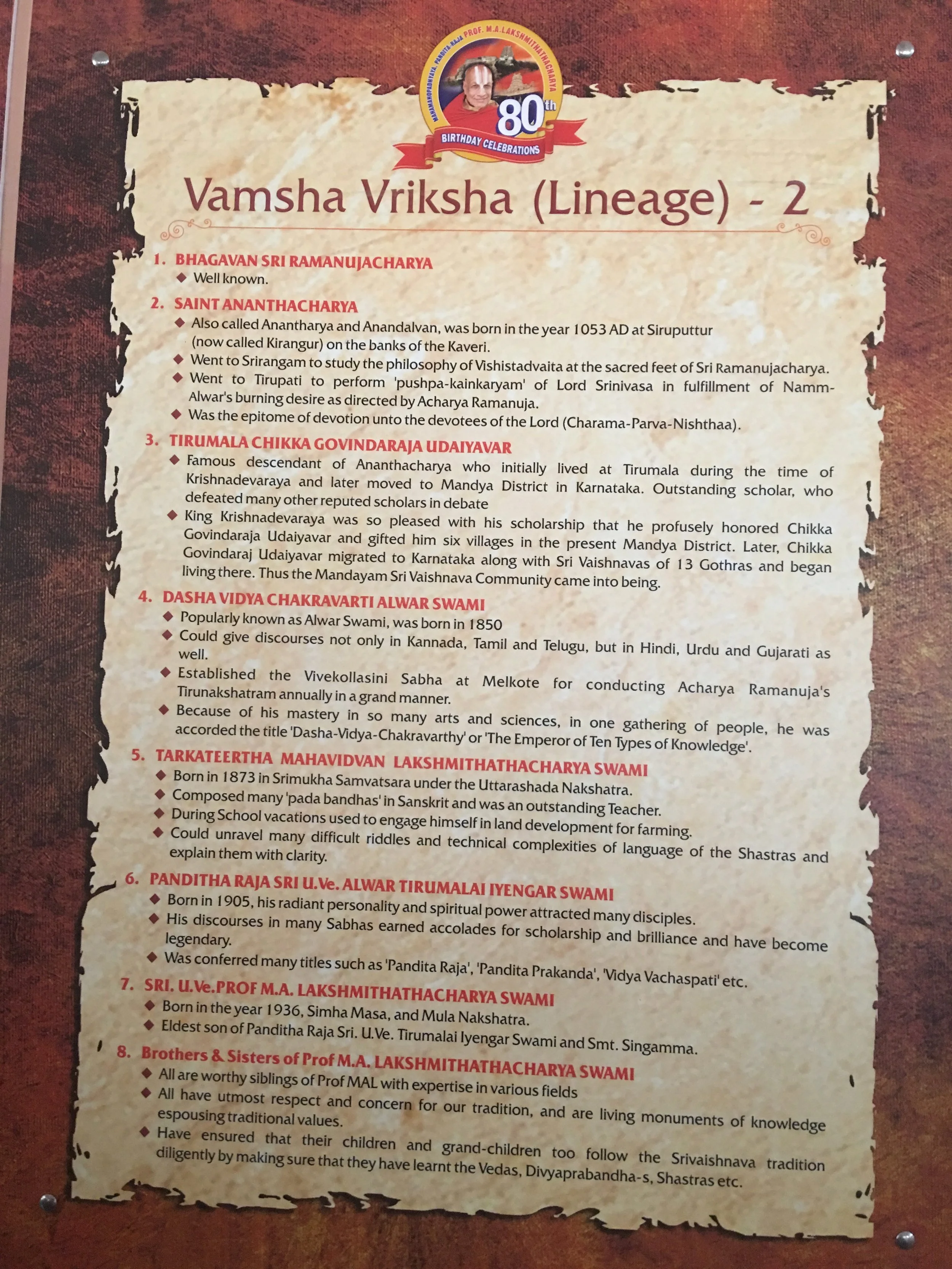
Periya Lakṣmīthāthāchārya Swami
Contemporary of Mummaḍi Kṛṣṇarāja Wodeyar · attained liberation May 1866
Eleventh generation in the Govindarāja Wodevar dynasty. He came to the Ācārya Pīṭha at a time when the lands granted by Kṛṣṇadevarāya had been seized during Tipu Sultan's rule. With no endowment to draw upon, he sustained the paramparā through cultivation of his own land and the devotion of his śiṣyas, a material circumstance that required as much steadiness of character as any debate or scholarship.
He lived in Mandya, in a house on Janārdana Swāmi Temple Street with a doorframe carved from stone, known to the community as the residence of the Svayam Puruṣa Ācāryas.
The pearl necklace
The quality of his character is illustrated by a single recorded episode. While distributing tīrtha to a large gathering in Mandya, he was observed by Mummaḍi Kṛṣṇarāja Wodeyar, who stopped, came forward to receive tīrtha, and was so moved by Swami's bearing that he placed his own pearl necklace in his hands. The string broke; the pearls scattered across the floor.
Swami did not glance at them. He continued distributing tīrtha to the remaining disciples without a pause.
Several days later the king invited him to court and asked him to become Rāja Guru. Swami declined.
Daśa Vidyā Cakravartī Āḻvār Swami
Born 1850 · attained the lotus feet of the Lord 5 August 1924
Second son of Periya Lakṣmīthāthāchārya Swami. He lost his father at sixteen and his elder brother shortly after, and ascended the Ācārya Pīṭha at a very young age upon the urgent request of the śiṣyas. He rose to it.
His education was remarkable in its range. He studied Sanskrit under Pustakam Alasingrāchārya Swami at Mysore, then went to Chennai for Sanskrit literature, Alaṅkāra Śāstra, and the Divya Prabandham, winning first prize each year in the Veda Vedānta Vardhinī Sabhā. At Kāñcīpuram he mastered Tarka under Kunnapakkam Śrīnivāsāchārya Swami. Madhuvamāṅgalam Embar Jīyar Swami of Śrīperumbudūr, impressed by his ability, taught him the traditional texts, and at the same Jīyar's instruction Āḻvār Swami spent four years at Śrīraṅgam studying the Śrī Bhāṣya, Bhagavad Viṣaya, Viśiṣṭādvaita, and the allied śāstras under Tirupullungudi Jīyar.
He could give discourses in Kannada, Tamil, Telugu, Hindi, Urdu, and Gujarati. On the Niẓām's birthday, he delivered a discourse in Urdu that so impressed the Niẓām he was rewarded in open court.
He was conferred the title Daśa Vidyā Cakravartī, Sovereign of the Ten Sciences, in a single gathering of scholars who recognised his mastery of ten distinct fields of knowledge. He established the Vivekollāsinī Sabhā at Melkōṭe for the annual celebration of Rāmānuja's Tirunakṣatra, which continues to this day. Towards the end of his life he lived at Melkōṭe, performing maṅgala śāsana at the temple morning and evening.
Public service and legal advocacy
Beyond his scholarship and ministry, Āḻvār Swami used his standing to defend temples and devotees in the courts. He prevailed in religious debates before the rulers of Baroda and Indore.
When the Hyderabad State Government confiscated temple lands at Sītārām Bāgh, he travelled to Shimla and successfully argued the case before the Viceroy's Council, securing an order that restored the lands.
When the Tāyār shrine at the Govindarāja Temple in Cidambaram was demolished to make room for the extension of the Nāṭarāja Temple, he took the matter to the courts and had the shrine rebuilt.
Leading lawyers and jurists consulted him on Hindu Dharma Śāstra throughout his life.
Tarkatīrtha Lakṣmīthāthāchārya Swami
Born 1873 · attained final liberation 1926
Eldest son of Āḻvār Swami. His early schooling in Chennai revealed exceptional ability in mathematics and science, so much so that the śiṣyas grew alarmed at what modern education might do to a future Ācārya Puruṣa and pressed for his return before he could complete high school. He came back to Mandya and resumed traditional Sanskrit studies at Melkōṭe.
Later he sat the highest examination in Navya Nyāya, the Tarkatīrtha, at Calcutta, placed first, and returned with a gold bracelet and the title that became his name.
The four hundred paṇḍitas at the Mysore court
When Nālvāḍi Kṛṣṇarāja Wodeyar assembled some four hundred paṇḍitas of his court for an impromptu open examination, every scholar present declined to face it except two: Vidvān Yatirāja and Vidvān Tarkatīrtha Lakṣmīthāthāchārya Swami, both disciples of Paṇḍita Ratnam Kuppaṇa Iyengar. Both answered every question put to them. Both were awarded the title of Mahāvidvān. The king thereafter addressed Swami simply as "the Paṇḍit of Melkōṭe."
When Vidvān Yatirāja, his fellow disciple, died suddenly in a tragic incident of poisoning, their teacher Kuppaṇa Iyengar was so bereaved by the loss that he came to regard Tarkatīrtha Lakṣmīthāthāchārya Swami as his gyānaputra, his son in knowledge. The scholarly inheritance Yatirāja would have carried passed instead to Tarkatīrtha Swami.
He attained final liberation at a relatively young age, in 1926. The scholarship he embodied passed directly to his son.
Paṇḍita Rāja U.Ve. Āḻvār Tirumala Iyengar Swami
Born 1905 · attained final liberation 1973, Chennai
Eldest son of Tarkatīrtha Lakṣmīthāthāchārya Swami, and father of U.Ve. Prof. M.A. Lakṣmīthāthāchārya Swami. His early studies were at Melkōṭe; he later mastered Navya Nyāya at the Mahārāja's Sanskrit College, Mysore. He spent time at Śrīperumbudūr giving discourses, then returned to Melkōṭe and served the Mahāpāṭhaśāla as teacher and, in time, principal, as his father had been before him.
He was conferred the titles Paṇḍita Rāja, Paṇḍita Prakāśa, and Vidyā Vācaspati. His teachings were remembered by all who heard them for their extraordinary clarity. He restored the temple chariot at Melkōṭe, the ratha that carries the Lord through the streets of the pilgrimage town, which was in ruins, raising the funds himself. He organised the Aṣṭākṣarī Mahāyāga and presided for years over the Vivekollāsinī Sabhā for the annual celebration of Rāmānuja's Tirunakṣatra. He entrusted the tradition to his son with everything intact.
How this lineage was kept
It is difficult, at this distance, to grasp the strain under which each of these ācāryas held their position. The continuation of a Svayam Ācārya Puruṣa Paramparā depends on something more delicate than learning or institutional support. It depends on each generation receiving its formation entirely within the tradition, on the children of the line accepting a way of life their peers around them have largely set aside, and on the surrounding community remaining vigilant enough to protect the inheritance through the years when the pressures upon it grow.
Macaulay's system of education under British rule was the historical pressure point. It sowed doubt about the value of indigenous traditions and made modern education the route to material advancement. The temptation to gain English-language qualifications and the security that came with them broke many ācārya-puruṣa lines outright. Even Tarkatīrtha Swami above, the brilliant young mathematician in Chennai, was almost lost to the line in just this way, and was recalled by the śiṣyas before his school years were complete.
The same pattern continues, in different forms, today. The Māṇḍyam Ānandāṅpiḷḷai paramparā has been preserved because each generation of śiṣyas and family members has chosen to protect it actively, not as a matter of inherited duty alone but as a matter of vigilance. The continuance of a thousand-year inheritance is not automatic.
U.Ve. Prof. M.A. Lakṣmīthāthāchārya Swami
26 August 1936 – 15 May 2021
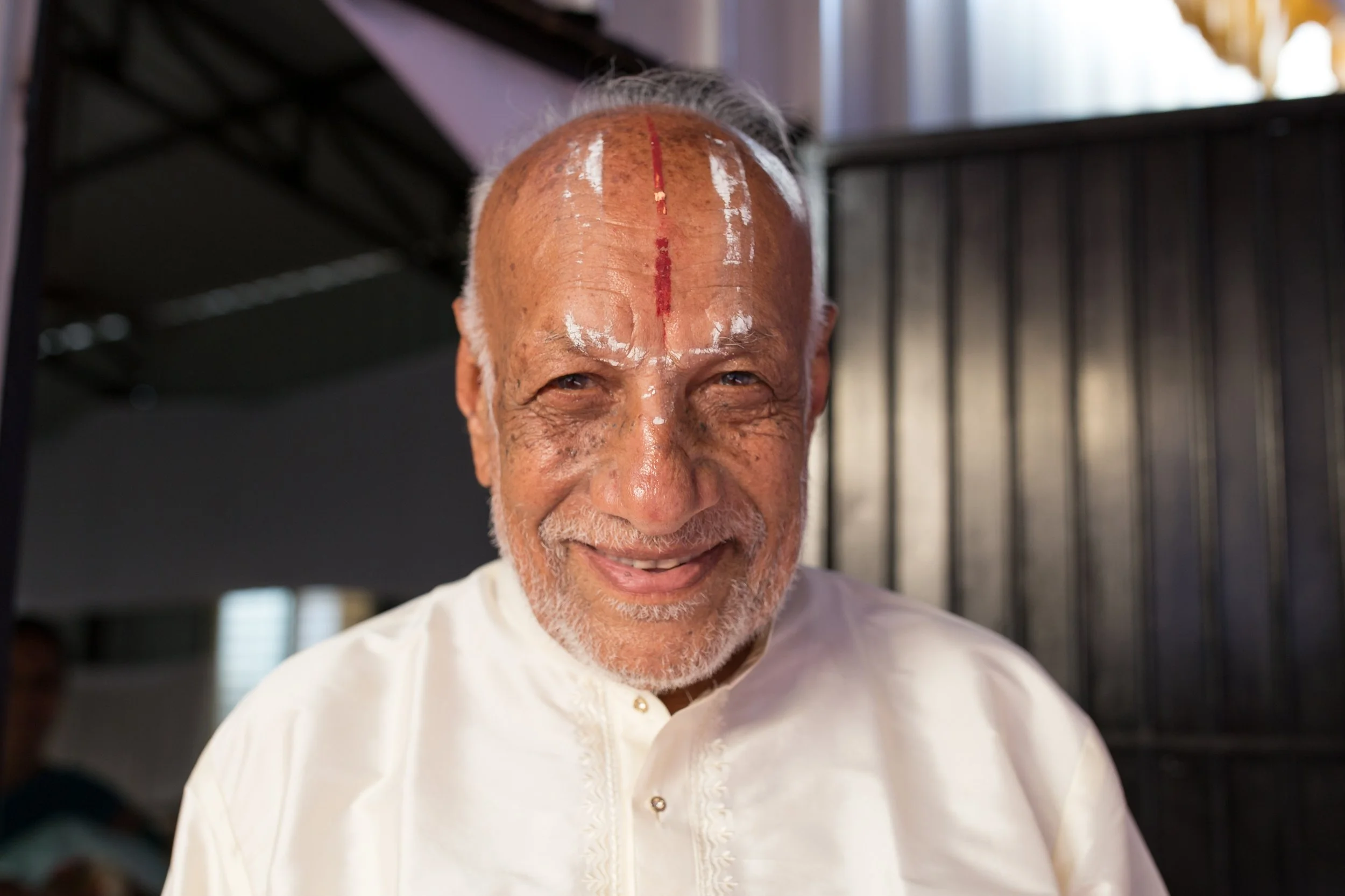
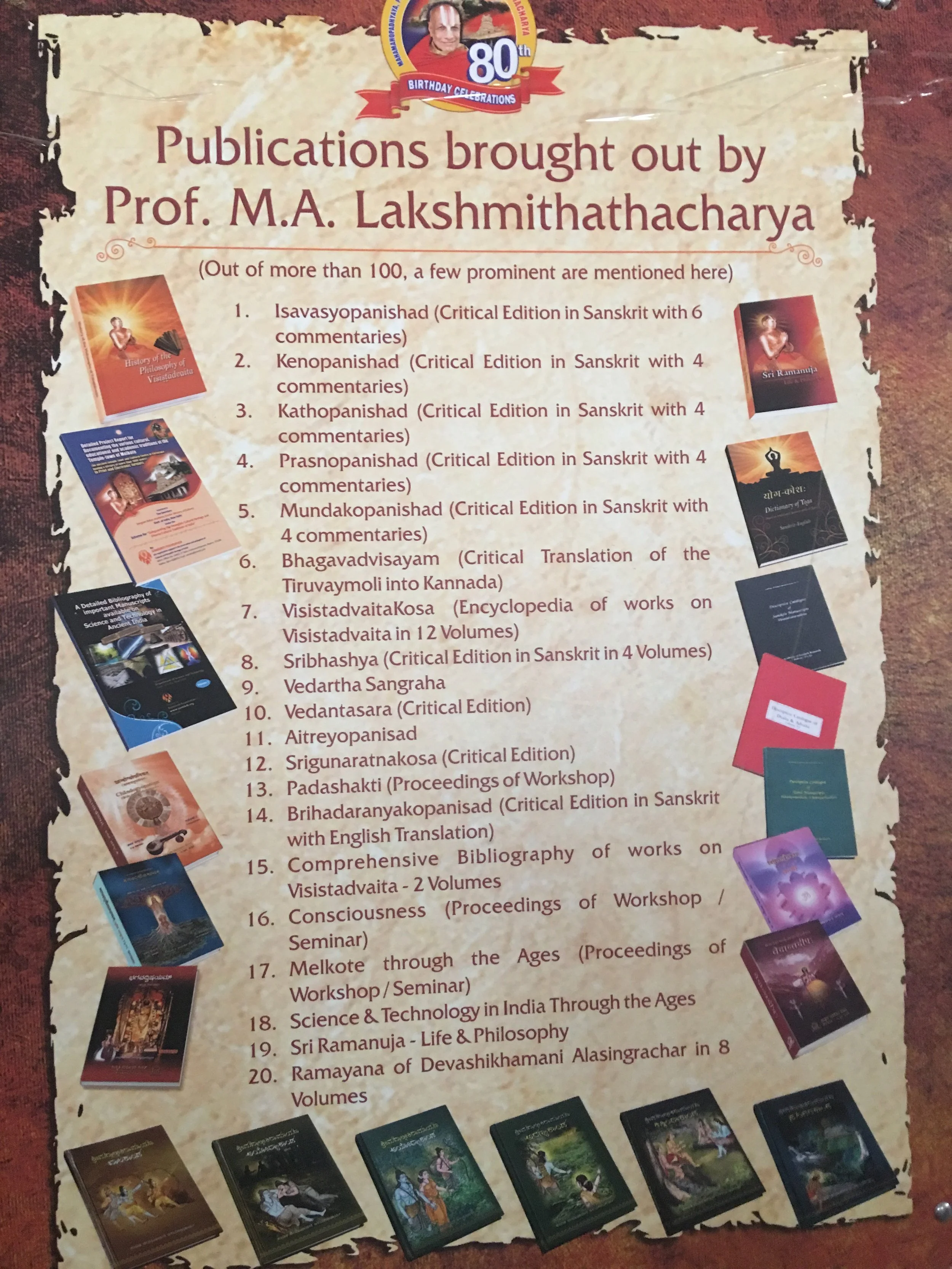
He was a Sanskrit scholar of the highest formal standing, the founder of a major Sanskrit research institution built from barren land in his ancestral village, a pioneer in computational linguistics for Indian languages, a recoverer of palm-leaf manuscripts that would otherwise have vanished, a classical musician trained in vīṇā, flute, and vocal traditions, the lead actor in G.V. Iyer's feature film on the life of Rāmānuja, and the ācārya of a tradition that had survived for nearly a millennium by the time it came to him. He carried it forward as if it had always been his to carry.
He was the son of Paṇḍita Rāja Āḻvār Tirumala Iyengar Swami and Smt M.A. Śiṅgamma. He was formed by his father at Melkōṭe, and the formation was exacting. As a boy he dismantled a new wooden toy to discover what lay inside, while his sibling preserved the other. His father scolded him for it. Years later, the same curiosity would drive him to harness early computer technology for Sanskrit manuscript analysis at a time when almost no one in India thought to combine the two. He described himself as a neo-traditionalist: firmly rooted in the śāstric inheritance, entirely open to whatever tools might serve it.
When his excellent secondary examination results were concealed from him by his father and the śiṣyas, for fear that the knowledge of his first-class marks would draw him toward modern education and away from the paramparā, his initial reaction was resentment. He came to understand it, in time, as the deepest expression of care anyone had shown him. The tradition had to be carried. He was the one who could carry it.
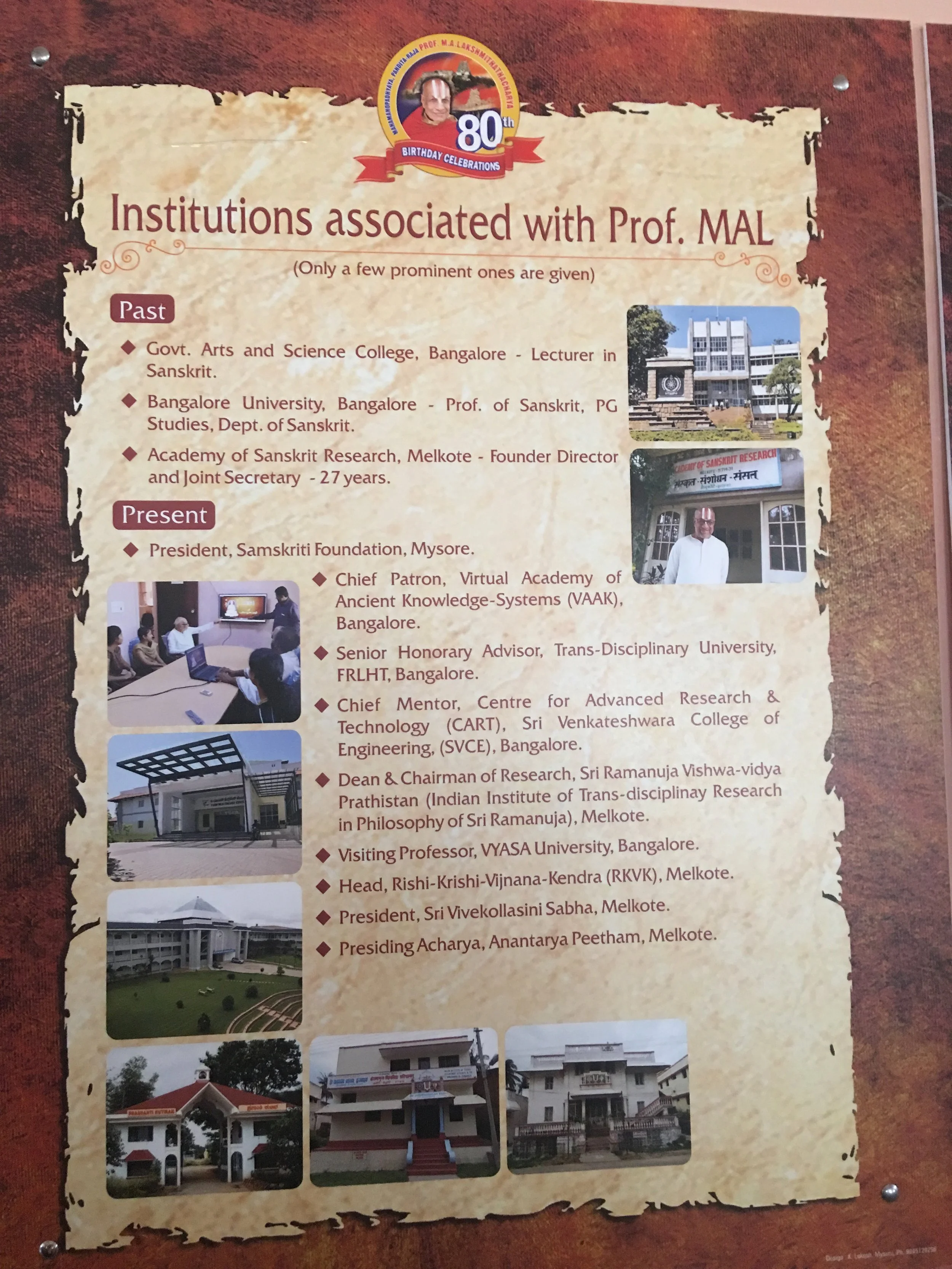
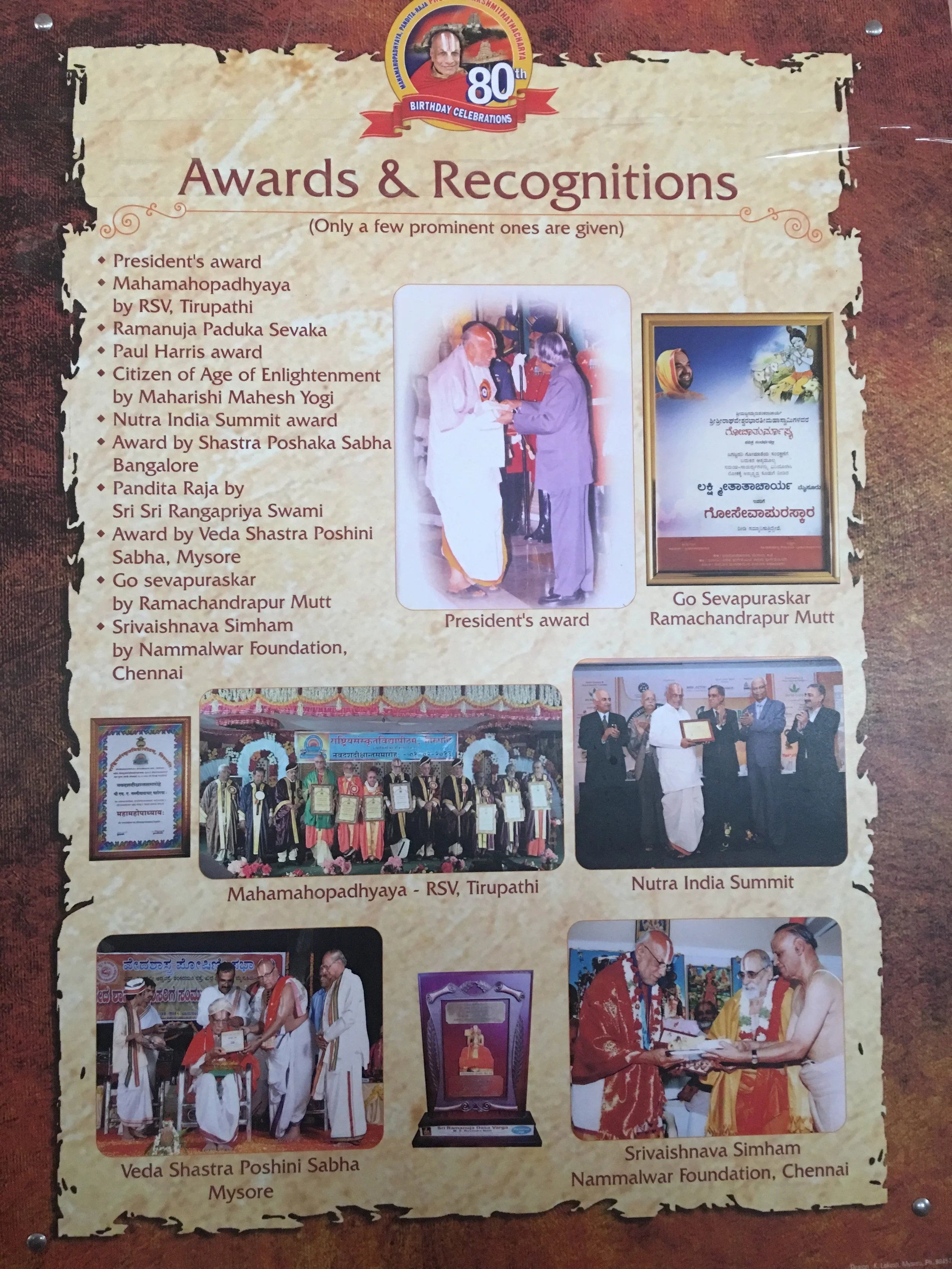
He carried it, and he expanded what it meant to carry it. He completed his B.A. at Mysore University with Sanskrit and Philosophy as majors. He completed his M.A. in Sanskrit at Madras University, first class first rank, with two gold medals. He qualified as Navya Nyāya Vidvān, again first class first rank, winning the President of India's Gold Medal. He added the Rāṣṭra Bhāṣā Pravīṇa qualification in Hindi and a certificate course in German. He served as lecturer at the Government College in Chitradurga, then at the Government College in Bangalore, then as Assistant Professor and Reader in Sanskrit at the Postgraduate Department of Bangalore University for ten years.
Then in 1977, having persuaded the Government of Karnataka to grant him fifteen acres of barren, rocky wasteland near Melkōṭe, he resigned his professorship and founded on it the Academy of Sanskrit Research. He had no financial assurance, no institutional backing, and no guarantee the Academy would survive its first year. He gave the next twenty-five years of his life to it.
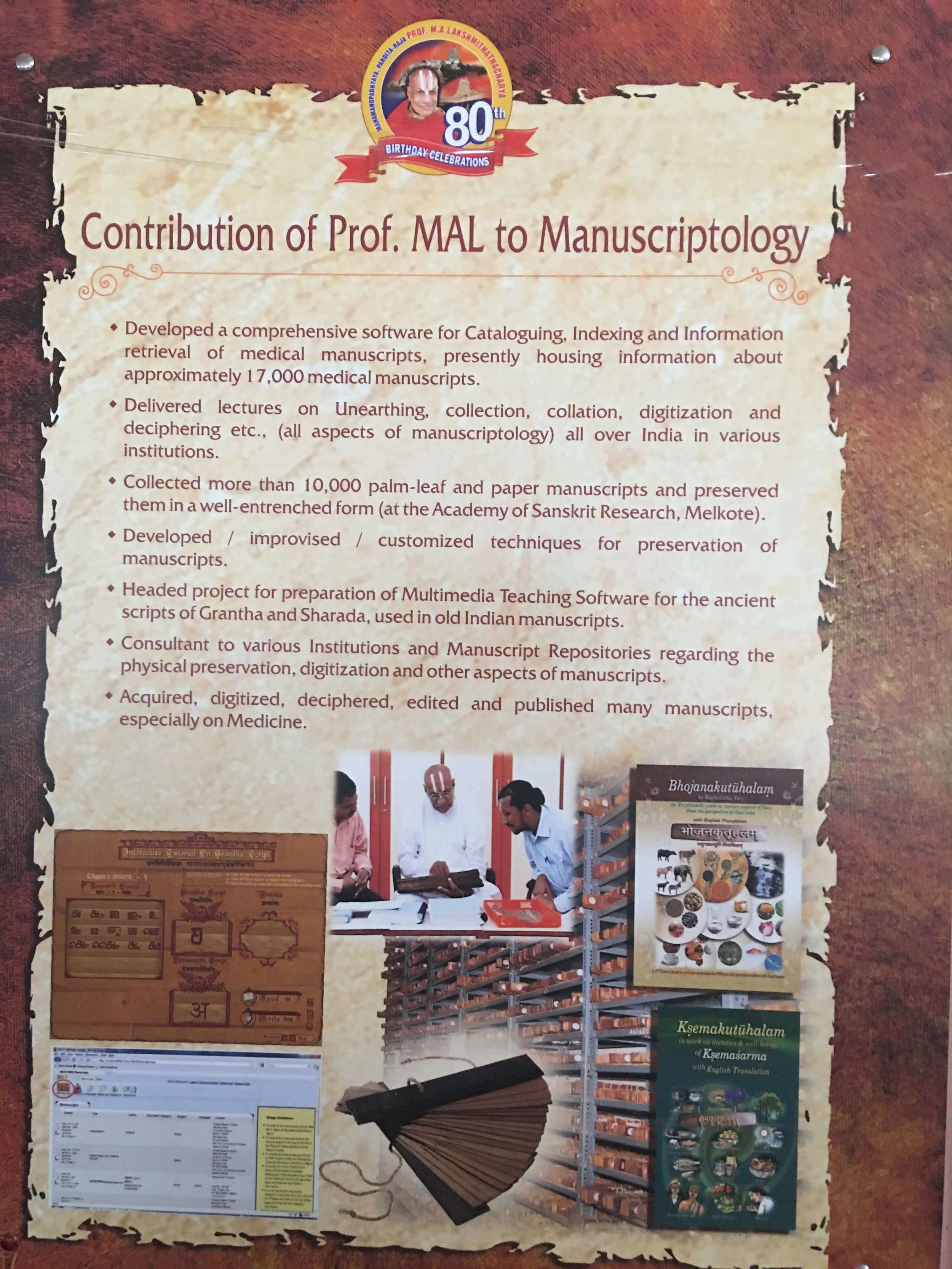
Following the ancient ṛṣi-kṛṣi-paddhati, the method by which the seers of antiquity restored wilderness to garden, he transformed the landscape entirely. The same act his ancestor Ananthāchārya had performed at Tirumala a thousand years before. He hauled in soil and water by the truckload. He selected the flora and fauna according to the local sthala-purāṇa. Three hundred species grew where there had been nothing. By the time he stepped down as director, the Academy held over 23,000 catalogued titles in its library and a collection of over 10,000 palm-leaf and paper manuscripts. The rarest had been sought out personally by Swami from family heirloom collections across India, and the most fragile microfilmed for preservation. Nearly fifty volumes of original research had been published. Software developed at the Academy under his direction addressed Sanskrit grammar analysis, speech synthesis, machine translation, language encoding, lexicography, language teaching, and metrical analysis. A museum, an in-house printing press, a desktop publishing facility, three all-India workshops, ten vidvat goṣṭhīs, and many seminars and short-term courses came into being on the campus. The Academy continues today.
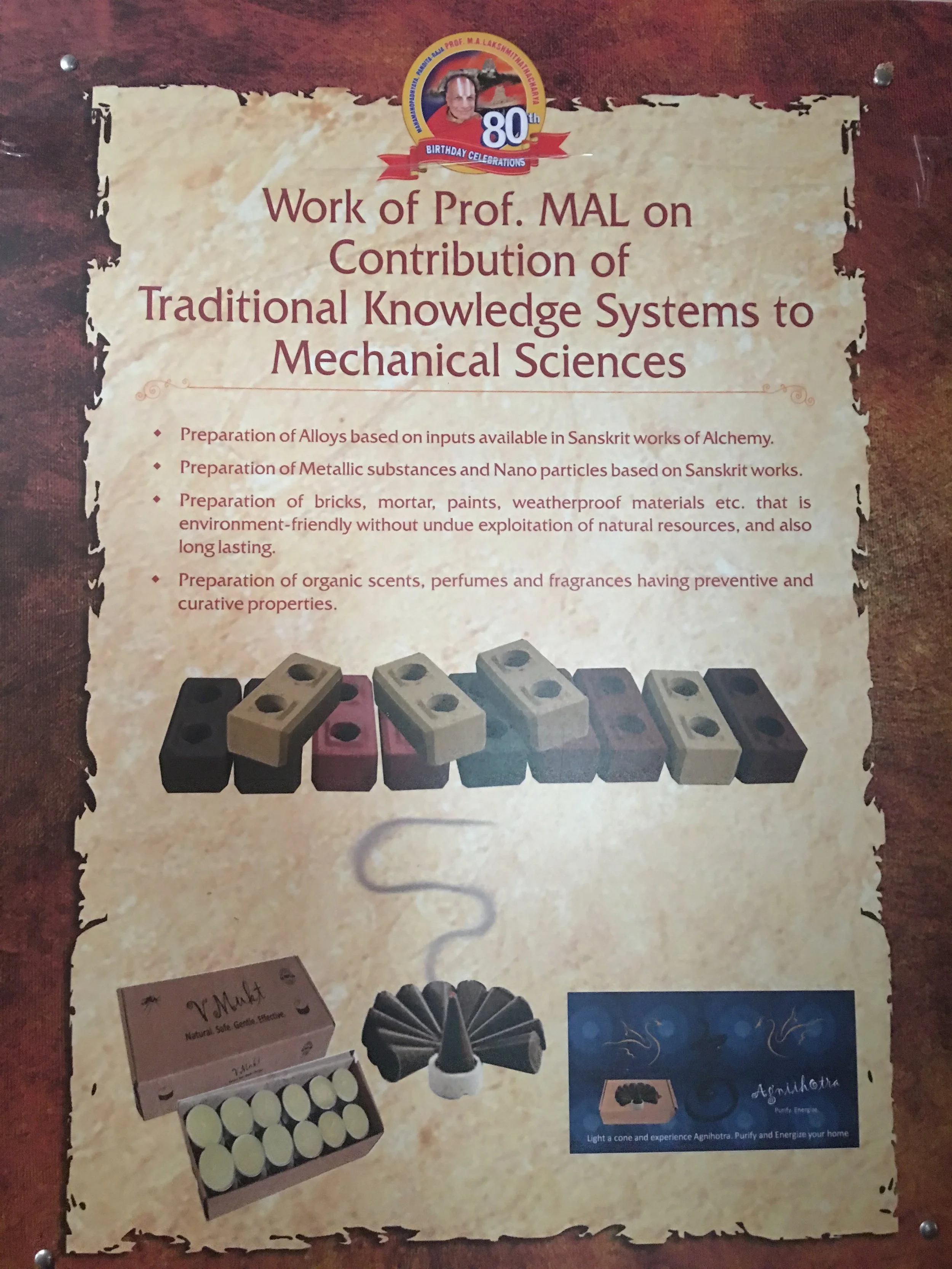
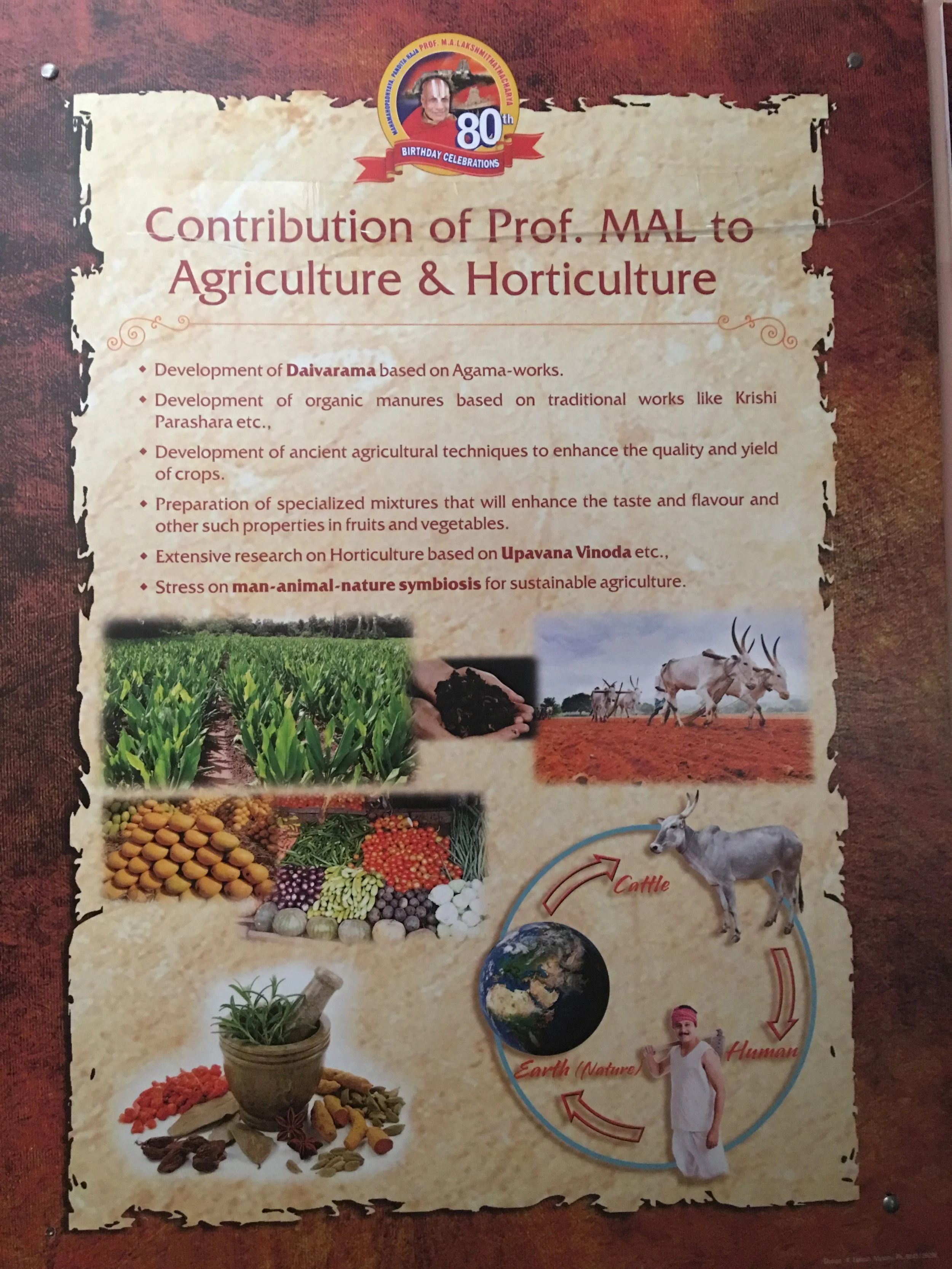
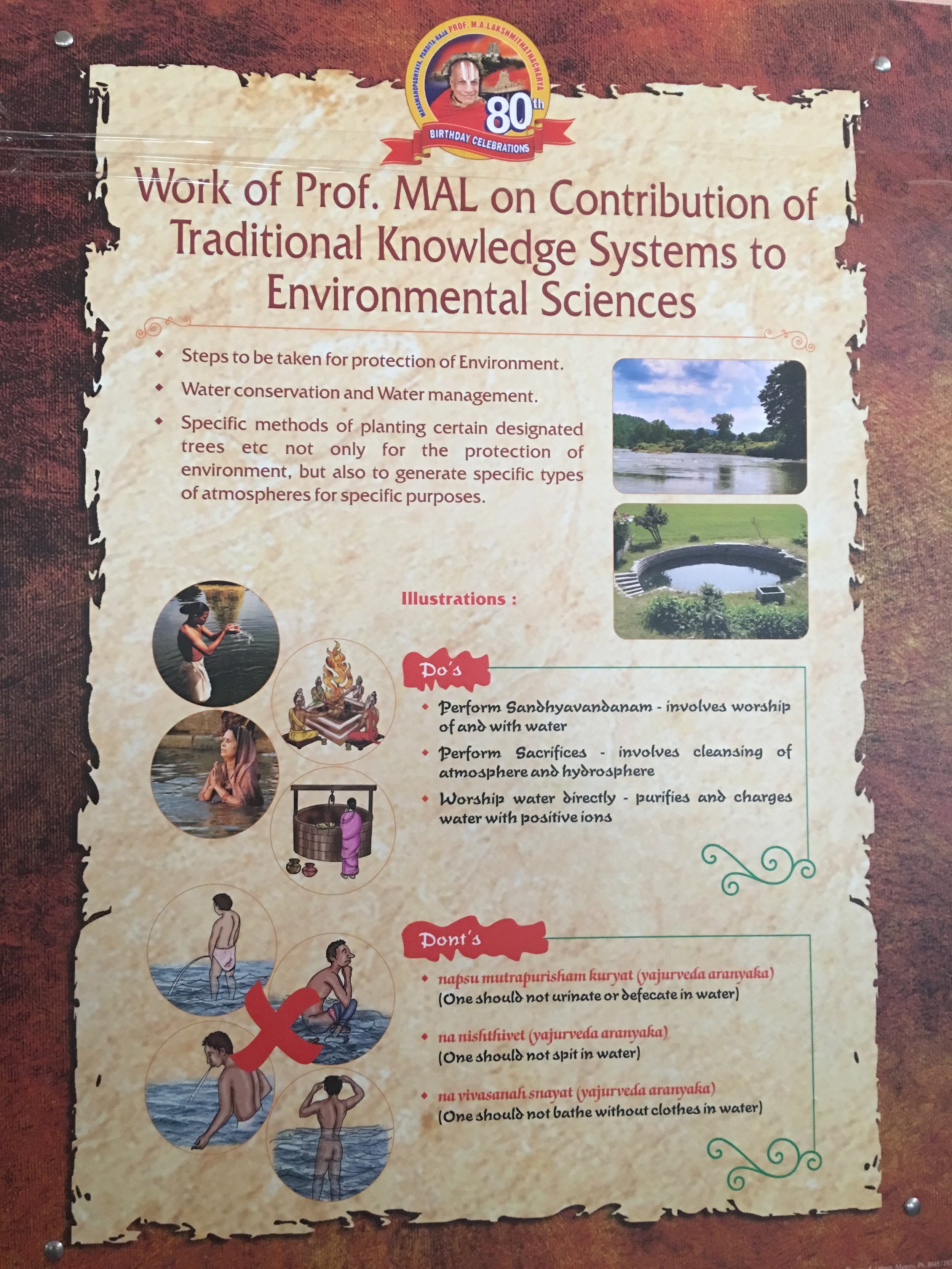
His vision extended far beyond what he was able to complete in one lifetime. He envisioned universities devoted to Viśiṣṭādvaita and its comparative study with other systems of philosophy, to Ubhaya Vedānta scholarship, and to Sanskrit applied through science and technology. He proposed research programmes that bridged ancient knowledge systems with contemporary disciplines: speech synthesis derived from the Śikṣā texts and the Prātiśākhyas, mathematics from the Vedic tradition, sustainable agriculture from the Kṛṣiparāśara, materials science from the Amśu-bodhinī, environmental ethics drawn from the four puruṣārthas, water management drawn from the temple-tank traditions. He proposed an institution for the training of temple arcakas in the Āgama tradition. He proposed a global network of meditation centres teaching the thirty-two vidyās described in the Śrī Bhāṣya. Many of these projects were already in motion at the Academy when he left. Many remain undertakings for those who come after him.
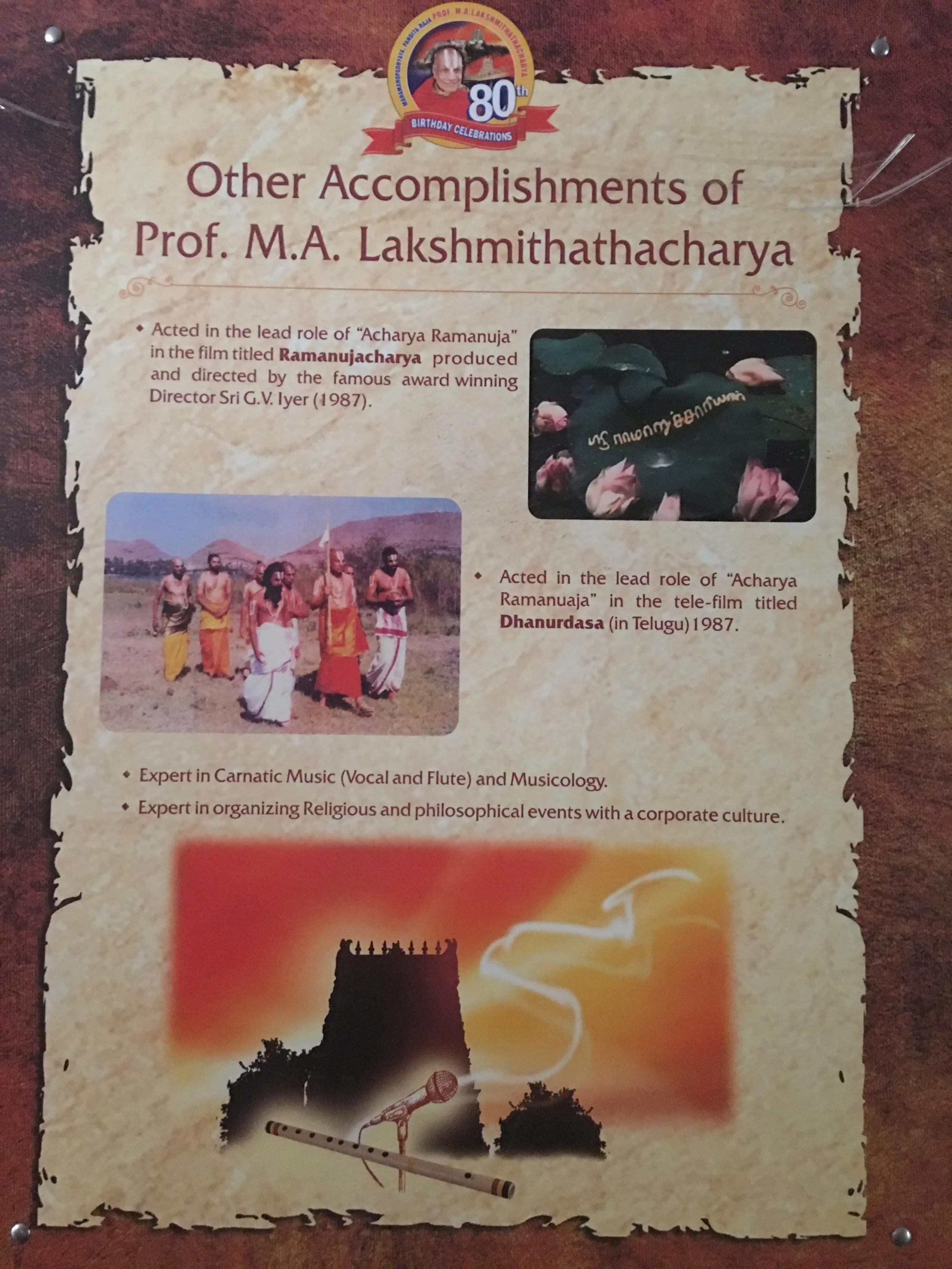
He played the lead role of Rāmānuja in G.V. Iyer's feature film Rāmānujāchārya. He received the President of India's Award for outstanding scholarship and contribution to Sanskrit. He was honoured with the title Citizen of the Age of Enlightenment by the Maharishi Mahesh Yogi Academy of Science and the title Rāmānuja Pāduka Sevaka at the Mudali Āṇḍāṉ Tirumaligai in Chennai in 2001. He served on the Central Sanskrit Board of the Government of India, as Senate Member of Rashtriya Sanskrit Vidyapeetha at Tirupati, on the Advisory Committee for Technology Development of Indian Languages at the Ministry of Information Technology, on the supervisory committee of the Carnegie Mellon Digital Library of India project, as Honorary Fellow at the Institute of Advanced Studies in Shimla, and as Senior Advisor to the National Institute of Advanced Studies in Bangalore.
Through all of it, he remained what his lineage required him to be: the living Ācārya Puruṣa. He gave dīkṣā. He ministered to śiṣyas. He continued the pañcakāla parāyaṇa without interruption. He made himself available to anyone who came to him in sincere search. Scholars came from around the world to the Academy. Yoga practitioners came. People who could not easily say why they came, came, and left with something they could not easily name. He made time for all of them.
His wife, Ammangar M.A. Godhā, was his equal partner throughout. Her learning, wisdom, and unwavering support were, by every account, the ground on which his work stood. Swami himself attributed at least sixty per cent of the Academy's achievements to her. Together they raised both their sons in traditional education and the Vedic way of life, in full knowledge of what they were asking those sons to accept, and what material prospects they were asking them to set aside. No account of Śrī U.Ve. Prof. M.A. Lakṣmīthāthāchārya Swami is complete without her.
He attained final liberation on 15 May 2021, at the age of eighty-four.
The paramparā, the only surviving Svayam Ācārya Puruṣa Paramparā among the seventy-four Iyengar lines Rāmānuja established, passed to his son.
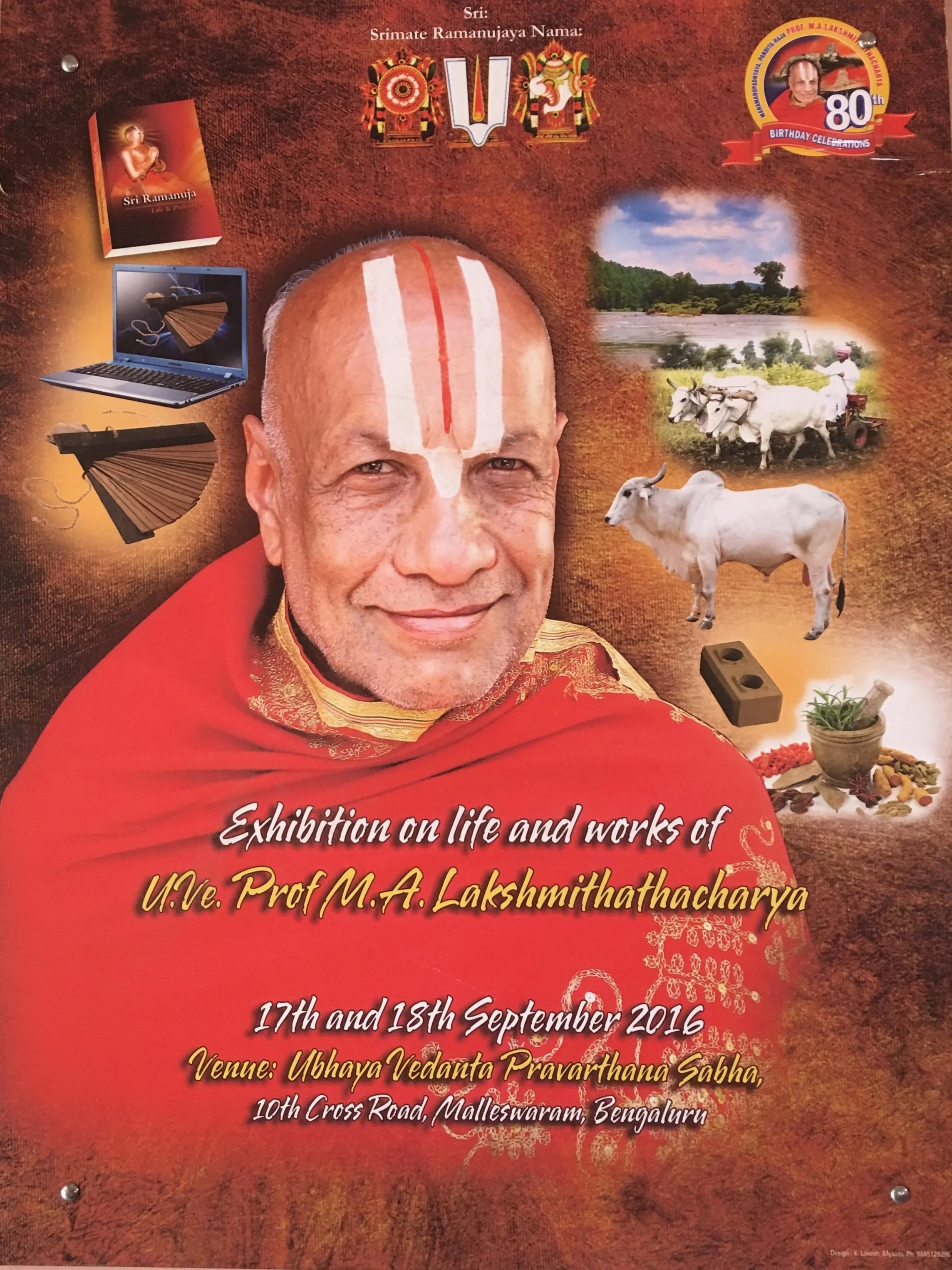
His formation in the arts, languages, and traditional knowledge
Swami's formation extended well beyond formal academic study. His mother, Smt M.A. Śiṅgamma, taught him the fundamentals of bio-farming and horticulture, encouraging him to cultivate a garden of plantain trees behind their house at Melkōṭe. Sri M.K. Sampath taught him to judge cattle by the old traditional methods, a body of practical knowledge most modern veterinarians have never encountered. Nallar Narāyaṇa Iyengar Swami trained him in the careful selection of vegetables and fruits at weekly markets, including the art of negotiation that came with it.
In music, Swami learned vīṇā under Prof. Rajalakshmi Tirunarayan, a disciple of Veena Venkatagiriappa. He then studied flute under Prof. V. Desikar (brother of Veena Doraiswami Iyengar) for nearly three years, passing the Junior Examination in Instrumental Music in first class. In Chennai he studied vocal music under Sandhyāvandanam Śrīnivāsa of Anantapur, and devoted three years to Devagāna, the divine music of the Divya Prabandham, under Śrīrām Bhāratī, a disciple of V.V. Śaṭakopan.
He played Lakṣmaṇa in Bhāsa's Pratimā Nāṭaka at Melkōṭe. He played Alasinga Perumāḷ in a play on Vivekananda at Vivekananda College, Chennai, in 1964. He played Rāmānuja in the drama Bibī Nācciyār during the Centenary Celebrations of the Vivekollāsinī Sabhā at Melkōṭe. He directed Bhāsa's Svapnavāsavadatta under the Postgraduate Department of Sanskrit at Bangalore University, a production that drew praise from scholars across India. He played Rāmānuja in the DD Hyderabad tele-play Dhanurdāsa and again in G.V. Iyer's feature film Rāmānujāchārya. He was interviewed on Udaya TV's Saṃskṛta Saurabha programme and as part of NDTV's series "50 Important Indians."
In addition to his mastery of Sanskrit, Tamil, Kannada, and English, he qualified as Rāṣṭra Bhāṣā Pravīṇa in Hindi and held a certificate in German.
Building the Academy of Sanskrit Research
In 1977, Swami persuaded the Government of Karnataka to commission an Academy for Sanskrit Research at Melkōṭe. The Government granted him fifteen acres of utterly barren, rocky wasteland and no further assurance. He was left to his own devices thereafter. He resigned his university post and met the challenge head on.
With ingenuity and sheer hard work, Swami transformed that desolate landscape. He arranged for the transportation of vast amounts of soil, water, and other materials to the site. He selected the flora and fauna by the sthala-purāṇa of Melkōṭe. He then adopted the ancient ṛṣi-kṛṣi-paddhati, the method by which the seers of antiquity cultivated wild land, letting nature work freely. Soon the place that had looked like a lunar landscape resembled the garden of an ancient forest hermitage, with over three hundred species of plants growing vigorously in mixed wilderness. He restored eight kalyāṇī ponds on the campus. He blended every new construction into the natural setting so as not to disturb the ecology. In effect, Swami re-enacted at Melkōṭe what his ancestor Ananthāchārya had done at Tirumala a thousand years before.
Over twenty-five years, the Academy became an institution of national and international standing. The library accumulated 23,000 catalogued titles. Over 10,000 palm-leaf and paper manuscripts were collected. Swami personally tracked many of the rarest from family heirloom collections across India, persuading their custodians to part with them or to allow them to be microfilmed for preservation. Nearly fifty volumes of original research were published. Computerised semantic processing was developed. Software was created at the Academy for Sanskrit grammar analysis, speech synthesis, language encoding, machine translation, lexicography, language teaching, and metrical analysis. Programmes were developed on the Śrī Bhāṣya and the Taraka Mañjūṣā. A museum was set up housing rare ethnic and cultural artifacts, icons, coins, and paintings. Three all-India workshops were conducted. Ten vidvat goṣṭhīs were convened. Numerous seminars, short-term courses, and teaching programmes were held.
Visitors came from all parts of India and the world, from village pilgrims to heads of national institutions. The atmosphere of the Academy, set in a garden resembling an ancient hermitage and presided over by an ācārya of inspiring personality and spiritual strength, drew people whether or not they had come to Melkōṭe with any prior interest in Sanskrit. Many recorded their impressions in the visitors' book in their own hand.
After twenty-five years, circumstances brought Swami's stewardship of the Academy to a close. The institution itself continues today, and the foundation he laid for it is the reason it stands at all.
Services to Melkōṭe and the temple traditions
Swami's contribution to the temple town of Melkōṭe extended well beyond scholarship. He was responsible for the conversion of the Melkōṭe Municipality into a Gram Panchayat, which opened the way for development grants. As a member of the Managing Committee of the Cheluvanārāyaṇa Swāmi Temple complex, he oversaw the Kalaśa Pratiṣṭhāpana that had been pending for more than a decade, the cleaning of the puṣkariṇī tanks for the first time in two hundred years, and the restoration of the famous Kalyāṇī tank.
He personally approached the then Home Secretary of the Government of India to secure sanction for major repairs to the Nan-Muhan (Four-Faced) Gopuram of the Cheluvanārāyaṇa Swāmi Temple, which had been pending for decades. He was responsible for the installation of an electricity transformer sub-station at Melkōṭe, which radically improved the town's previously erratic power supply. He was the first to propose the proper water-supply scheme that now brings water to Melkōṭe from Tondanūr.
He organised and personally participated in the 600th Utsavams of Maṇavāḷa Māmuni, Vedānta Deśika, and Pillai Lokāchārya, which had been suspended for years due to internal Teṅkalai-Vaḍakalai differences. As Secretary of the Vivekollāsinī Sabhā he led its Centenary Celebrations, a five-day cultural programme, and built the new Sabhā building on a 4,400 square-foot plot.
Throughout, his concern was to preserve Melkōṭe as a jñāna-maṇṭapa, a hall of wisdom, rather than allow it to become commercialised as a tourist destination. It is doubtful that anyone else has matched the depth of his foresight for the spiritual development of Melkōṭe and its inhabitants.
Dr. M.A. Alwar
Senior Professor, Mahārāja's Sanskrit College, Mysore
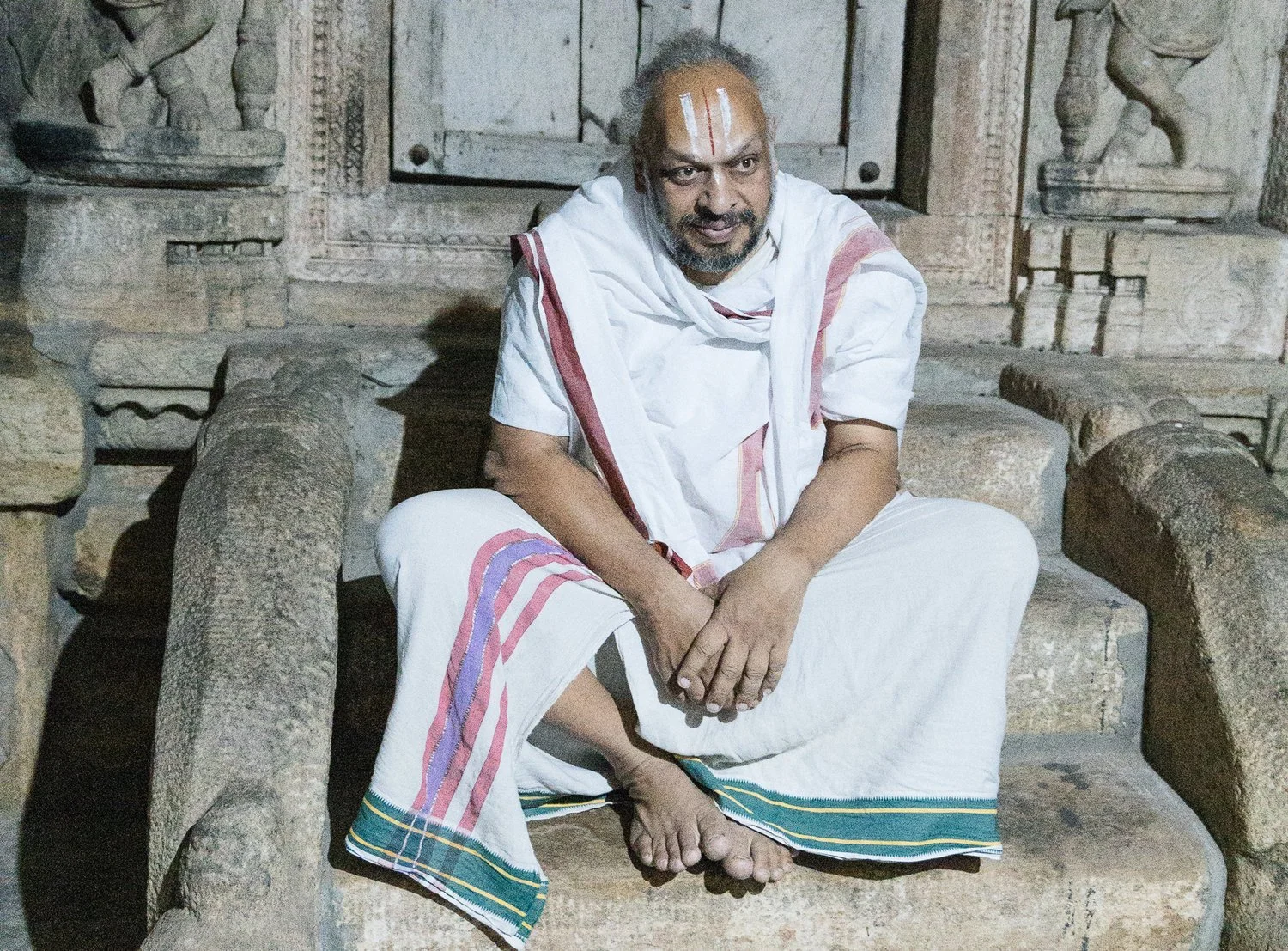
Son of Śrī U.Ve. Prof. M.A. Lakṣmīthāthāchārya Swami. Formed within the same tradition, in the same household, through the same exacting standards of Vedic education and śāstric learning that shaped every generation of this line before him. Following in his father's footsteps, he continues the work his father gave his life to: the living scholarship, the institutional mission, and the spirit of openness that have always characterised this paramparā. He supported his father's work at the Academy throughout its development, without ever holding a formal position there.
He is Senior Professor at the Mahārāja's Sanskrit College, Mysore, and Managing Trustee of the Saṃskṛti Foundation. He is co-organiser of the Mysore Yoga Conference, an annual gathering that brings together Sanskrit scholars and yoga practitioners from around the world to study the texts, philosophy, and practice of yoga at its source.
He believes that knowledge is meant to be shared. This is not a casual conviction but a considered position rooted in the tradition itself: the door of Śrīvaiṣṇavism, as Rāmānuja established it, is open to all who sincerely seek. Dr. Alwar has extended that openness to the global community of yoga practitioners, people drawn to the practice that emerged from this very tradition, who deserve to understand the philosophical ground beneath their feet.
His generosity in sharing the teachings of this paramparā with the world is what makes the Mysore Yoga Traditions program possible.
Śrīvaiṣṇavism: The Philosophical Foundation
The philosophy of Viśiṣṭādvaita, propagated by Rāmānuja and his predecessors, is rooted in the Upaniṣads, the Brahma Sūtras, and the Bhagavad Gita. The Āḻvārs of South India experienced these truths directly; their outpourings, the Divya Prabandham, form the Tamil canon of the tradition. Together with the Sanskrit Vedānta, they constitute the Ubhaya Vedānta, the twin canon central to all Śrīvaiṣṇavas. The tradition also holds the Pāñcarātra and Vaikhānasa Āgama traditions, and the Rahasya tradition.
What distinguishes Śrīvaiṣṇavism is the direct, person-to-person relationship between ācārya and śiṣya. The aspirant begins with samāśrayaṇa, approaching an ācārya of the sampradāya in complete sincerity. If accepted, the aspirant is then received into the tradition through the Pañca Saṃskāra, the five rites of initiation that form the core of the Iyengar tradition. The rites themselves are personal and not named here. Following Rāmānuja's tenets, the door is open to all who sincerely seek, regardless of caste, creed, or background.
A closing note
My deepest gratitude goes to Dr. M.A. Alwar and the Saṃskṛti Foundation for their generosity in sharing this knowledge with the wider world of yoga practitioners. That generosity is itself an expression of the tradition, which has always held that the door is open to all who sincerely seek.
If this page has sparked your curiosity, the Saṃskṛti Foundation is the place to go deeper. Dr. Alwar is available to teach in Mysore year round, helps each year with organising the Mysore Yoga Conference, and teaches in our Online Studies program. We are grateful for his continued guidance.
Śrīmate Rāmānujāya Namaḥ
Śrīmad Anantārya Mahāgurave Namaḥ