Joining Sun and Moon
An Introduction to Hatha Yoga and the Practice of Prana-Sakshi
ॐ
śrī-ādi-nāthāya namo'stu tasmai
yenopadiṣṭā haṭha-yoga-vidyā |
vibhrājate pronnata-rāja-yogam
āroḍhum icchor adhirohiṇīva ||
Salutation to Adinatha (Shiva), by whom the science of Hatha Yoga was taught — a knowledge that shines forth like a staircase for one who wishes to ascend to the lofty Raja Yoga.
— Hatha Yoga Pradipika 1.1
The Hatha Yoga Pradipika opens, as nearly every classical text does, with an invocation. Here it is addressed to Adinatha, the "primordial lord," a form of Shiva who is regarded as the originator of Hatha Yoga. Shiva is said to have taught the practice to his consort Parvati, and from that intimate beginning the teaching spread outward through a lineage of masters. It is worth noticing that each of these texts is anchored to a particular form of divinity in this way; the opening salutation is not ornament but an acknowledgment of the source from which the knowledge is felt to descend.
The Meaning of Hatha
When most people hear the words "Hatha yoga" today, they think of physical practice — and those practices are certainly present. But the term carries deeper connotations. Hatha means force, or insistence. In one well-known reading it is taken syllable by syllable: ha is the sun and tha is the moon. Yoga means to join. To practice Hatha yoga, then, is to join the sun and the moon.
Within the body, the sun stands for prana and the moon for apana. These are two of the five vayus, the classical "airs" or currents of vital force. Prana is the upward, enlivening current that brings in energy; apana is the downward force that expels waste and cools the body. As long as these two currents move in their ordinary directions, there is constant movement and agitation. The aim of the practice is to unite them and draw them into the central channel, the sushumna. When prana and apana are joined and gathered into the sushumna, their restless motion grows still — and as the breath grows still, so does the mind.
This is the heart of the matter. The calming of the mind is central to everything that follows. Calm the breath, and we calm the mind.
The Restless Mind
The mind is the swiftest thing in the world — its speed is sometimes named manovega, the velocity of thought. To still it is no small task. In the Bhagavad Gita, Arjuna confesses to Krishna that restraining the mind seems as difficult as catching the wind. Anyone who has tried to sit quietly knows the truth of this at once.
The union of prana and apana is therefore the real work of Hatha yoga, and the asanas are the primary means of preparing the body to undertake it. This is an important corrective, because the body-centred side of yoga is so often over-emphasized. Asana is not the goal; it is a preparation for pranayama.
Practice, Not Books
There is an old story that makes the point. Someone asked how many teeth a horse has. To settle the question they went to a library, looked it up, and found different numbers given in different books — so they fell to debating which figure was correct. At last someone simply brought a horse into the library and counted its teeth directly. Real authority and real knowledge come only from practice. Books cannot teach you the actual yoga; they can only describe the techniques that lead toward it. As one teacher put it bluntly: the problem is you, and you are also the answer.
Pranayama, in this light, is a path inward. It is nothing more mysterious than the witnessing of one's own prana.
The Text and Its Order
The text we study, and on which this course is based, is the Hatha Yoga Pradipika, composed by Svatmarama around 1550. It treats asana, pranayama, mudra, bandha, and finally samadhi. The order is deliberate: asana is taught first, and only then pranayama. Notably, kundalini is not so much as mentioned until asana, pranayama, mudra, and bandha have all been addressed; the samadhi practices stand as the culmination of everything that comes before.
Sri Krishnamacharya held the view that nothing foreign should be introduced into the body, and for this reason he did not accept the shatkarmas — the six cleansing actions, sometimes called the shatkriyas. Although these techniques are described in the text, and although some people do benefit from them, he neither practiced nor taught them.
The primacy he gave instead was to the breath, which is considered the principal means of creating change in the nervous system. The same emphasis appears in Patanjali's Yoga Sutras, where pranayama is mentioned in several places: the breath is to be made gradually long and subtle, and inhalation, exhalation, and retention together constitute pranayama. When the breath is regulated in this way, the mind gradually becomes clear, and many of its afflictions — and even physical illnesses — can be relieved through pranayama and the meditation that naturally follows from it. It is widely accepted that in advanced pranayama practice the breath can come to stop altogether.
Witnessing the Breath
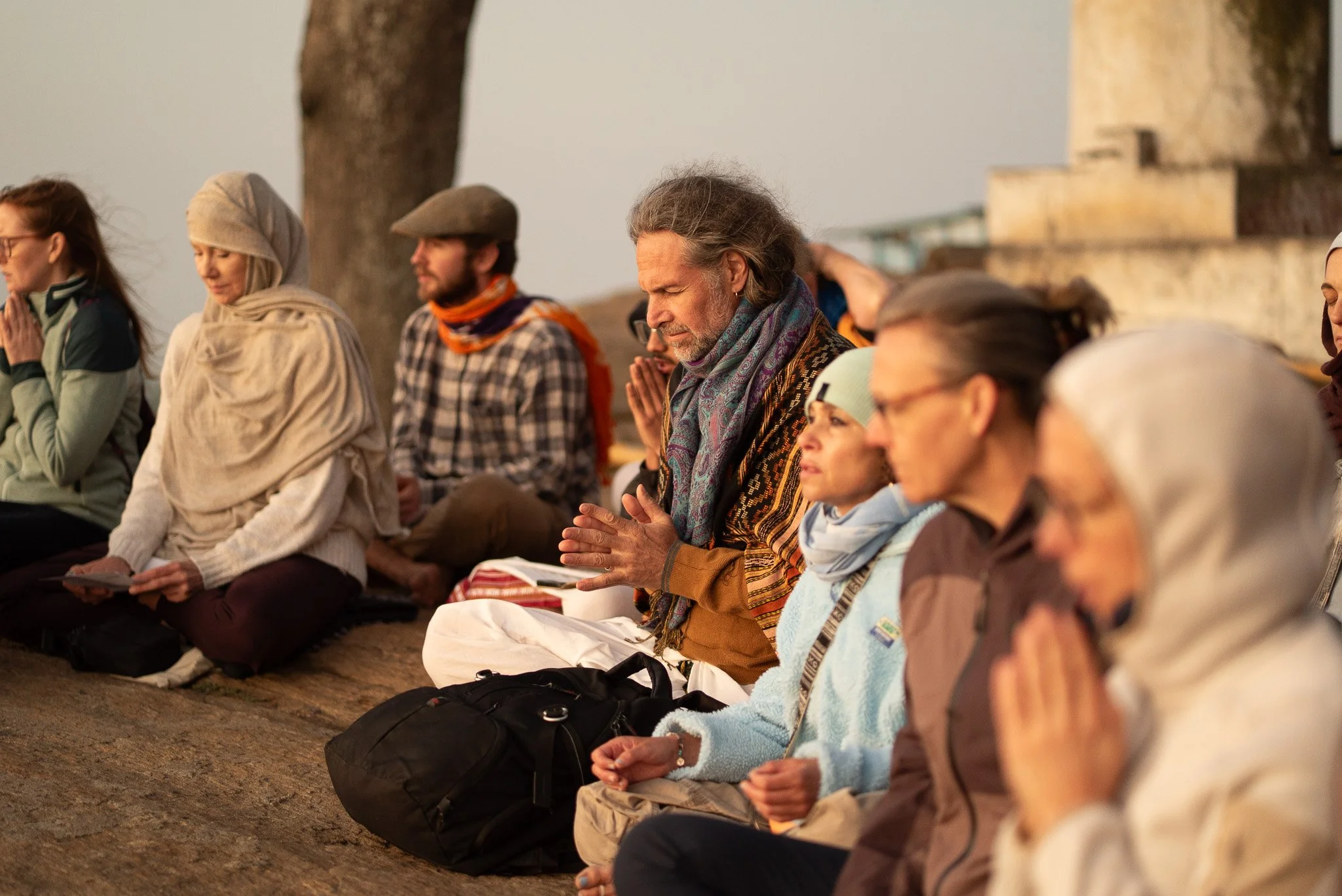
The practice we did today is prana-sakṣi — simply observing the breath, becoming the witness of one's own prana. To develop the ability to govern the attention is essential to all of yoga. Impulsive behaviour and a mind that jumps about are the greatest hurdle we face at the very outset, and learning to steady the attention is how we begin to overcome it.
Food, lifestyle, and mental state all bear directly on these practices and cannot be set aside. And the breath itself is best thought of as a tiger: powerful, and to be tamed only gradually — never by force.