Mudra
The Sacred Seals
Dr. M. Jayaraman The Ten Mudrās of Classical Haṭha Yoga
Study the bandhas familiar from yoga practice and the ten classical mudrās described in the Haṭhayogapradīpikā.
Begins Sunday, November 29, 2026 · 10 Sundays · Online · $108 USD
What you will learn
If you practice Ashtanga Vinyasa Yoga, you already know something of the bandhas. You may have heard instructions for Mūla Bandha or Uḍḍīyāna Bandha while practicing postures and vinyasas. In the older Haṭha Yoga texts, these techniques belong to a much larger body of practices called mudrās, or seals.
Over ten Sunday sessions, Dr. M. Jayaraman will guide us through the three fundamental bandhas and all ten mudrās named in Chapter Three of the Haṭhayogapradīpikā. We will examine what the text actually says, how traditional commentators explain it, and where these practices fit in relation to āsana, prāṇāyāma, and concentration.
You will have the chance to clarify familiar instructions from your own practice, learn the Sanskrit names and meanings, and understand why the classical teachers gave mudrā such an important place in yoga. Selected foundational work will be discussed in practical terms. More advanced methods will be studied through their descriptions, with respect for the need for qualified individual guidance.
The course is open to sincere yoga students and teachers. The Sanskrit will be explained as we study the passages, so you can follow the material without having previously studied the language.
How mudrā relates to the yoga you know
In Ashtanga Vinyasa Yoga, breath, movement, and bandha are taught together. The Haṭhayogapradīpikā gives us another perspective on some of the same terms. Its third chapter describes bandha within a larger system of mudrā, where the body and breath are used in preparation for more internal practices.
This makes the study useful even if your daily yoga is primarily āsana. We can look more carefully at what Mūla, Uḍḍīyāna, and Jālandhara Bandha mean in the classical descriptions, how they relate to prāṇāyāma, and why a practice familiar from the mat may have a broader application in Haṭha Yoga.
What we will cover
Mūla Bandha, Uḍḍīyāna Bandha, and Jālandhara Bandha in classical Haṭha Yoga
All ten mudrās named by Svātmārāma, including Mahāmudrā, Mahābandha, and Mahāvedha
The connection between āsana, breath, mudrā, and prāṇāyāma
What bandha means in Ashtanga Vinyasa Yoga and in the older Sanskrit sources
How the Jyotsnā commentary explains the methods and vocabulary of the text
The traditional accounts of prāṇa, suṣumṇā, and kuṇḍalinī, studied in their own context
The ten mudrās in the Haṭhayogapradīpikā
Chapter Three, verses 3.6–3.7 of the Haṭhayogapradīpikā, names ten mudrās: Mahāmudrā, Mahābandha, Mahāvedha, Khecarī, Uḍḍīyāna Bandha, Mūla Bandha, Jālandhara Bandha, Viparītakaraṇī, Vajrolī, and Śakticālana. Svātmārāma includes the three bandhas in this group rather than treating them as a separate subject.
The verses are brief. To understand them, Dr. Jayaraman draws on the Jyotsnā commentary of Svāmī Brahmānanda, which explains technical Sanskrit terms and brings in other classical sources. We will examine key passages with their meanings in English and see how the commentary adds to the original text.
In his foreword to the book drawn from Dr. Jayaraman’s Haṭhayogapradīpikā workshops, Yogācārya Śrī S. Sridharan places yoga within the Vedic tradition and emphasizes its transmission from teacher to student, or paramparā. He recalls how his teacher, Śrī T. K. V. Desikachar, read the Jyotsnā aloud and gave practical explanations. We will read selected Sanskrit passages with their commentary and discuss how the instructions relate to practice.
Why the practice is repeated
In explaining verse 3.5, the Jyotsnā glosses abhyāsa as repetition. The text calls for sustained practice, under guidance, rather than a technique tried once or twice.
Haṭhayogapradīpikā 3.5 · JyotsnāBrahmadvāra and suṣumṇā
The commentary explains Brahmadvāra, the gateway to Brahman, in relation to suṣumṇā, the central channel in the traditional subtle-body account. It is part of the text's explanation of kuṇḍalinī and mudrā.
Haṭhayogapradīpikā 3.5 · JyotsnāThe ten mudrās
Verses 3.6–3.7 name the ten practices, from the three bandhas to the more elaborate mudrās. Each has its own description and place within the discipline.
Haṭhayogapradīpikā 3.6–3.7What the text says they accomplish
The phrase jarā-maraṇa-nāśanam describes the mudrās as overcoming aging and death. We will examine this traditional claim in its philosophical setting. It is language from the classical text, not a promise of medical results.
Haṭhayogapradīpikā 3.7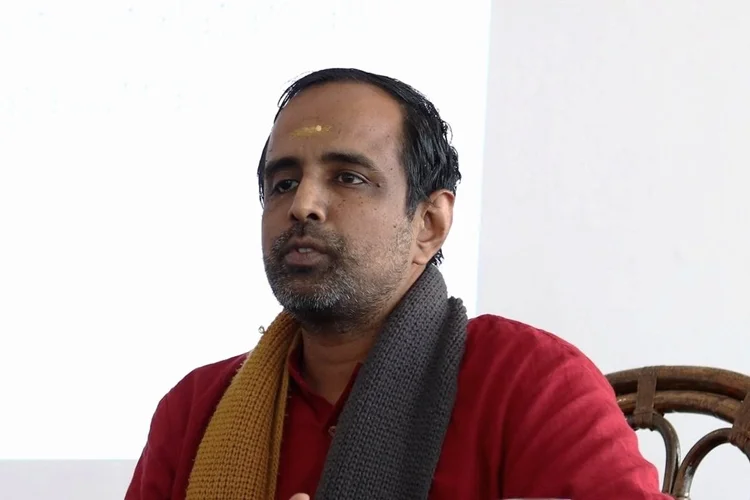
Dr. M. Jayaraman
Professor & Dean, Division of Yoga and SpiritualitySVYASA Deemed University
Dr. M. Jayaraman's formation began with seven years of traditional Gurukula education at Veda Vijnana Gurukulam in Bengaluru (1998-2005), studying Vedas, Vedānta, and Yogaśāstra under Prācārya Kotemane Ramachandra Bhat. He completed both his undergraduate and postgraduate degrees in Sanskrit with first rank and gold medal, and received his PhD from the University of Madras in 2010 with a dissertation on the Doctrine of Tantrayukti, the classical Indian science of text construction and methodology.
He is a direct disciple of Śrī S. Sridharan and served for over a decade as Director of the Research Department at the Krishnamacharya Yoga Mandiram, Chennai (2010-2021). The Krishnamacharya Yoga Mandiram was founded by T. K. V. Desikachar in 1976 to carry forward the teachings of his father, Śrī Kṛṣṇamācārya. Dr. Jayaraman brings his Gurukula training and years of textual research to the study of classical Yoga. Following his time at KYM, he served as Director of the Division of Textual Research in Yoga at the Indic Academy (2021-2022), and currently holds the position of Professor and Dean in the Division of Yoga and Spirituality at SVYASA Deemed University.
His published work spans twenty books and nineteen peer-reviewed journal articles on Yoga and Sanskrit literature. At the Krishnamacharya Yoga Mandiram he led textual immersion workshops on the Haṭhayogapradīpikā; their proceedings were prepared as a book for continuing study. His work with the Sanskrit verses and the Jyotsnā commentary provides the foundation for this course. He conducts international workshops on Tantrayukti and has been nominated to various academic boards and government councils. In 2021, Karnataka Sanskrit University awarded him the Samskrita Grantha Puraskāra for his Sanskrit work Mantra-artha-cintanam.
Recent contributions include Yogasya Bhāṣā, a four-part self-learning series on Sanskrit and Yoga, and Yoga-Vaiśāradī, a searchable web repository of classical Yoga texts. More of his work can be found at his Academia.edu profile.
If you would like to know more about the living Mysore Yoga tradition that informs this course, visit our Paramparā page.
From Past Students
Mysore Yoga Traditions online courses have enabled me to study with some of India's great living yoga scholars. For those of us who can't regularly travel to India it is an opportunity we may not have had otherwise. Attending these classes has given me a deeper and richer experience of yoga.
Lea BenderI highly recommend the Mysore Yoga Conference and online courses. They enable me to continue learning with professors I first studied with in Mysore in the 90s, and to discover new, dedicated pandits.
Kiki FlynnA deep and comprehensive online study program, with knowledge straight from the heart of India. Lectures and information directly from incredible and inspiring scholars and original lineage. Highly recommend for those wanting to go beyond just asana practice.
Rachel Butler · Oklahoma CityCourse dates and enrollment
Ten Sunday sessions online, beginning November 29, 2026, and ending January 31, 2027. The complete course fee is $108. We welcome all sincere students. The meeting time and enrollment link will be added when confirmed.
AFTER PAYMENT FILL OUT THE FORM BELOW TO RECEIVE ZOOM LINKS (THEY WILL BE SENT THE DAY THE COURSE BEGINS)
Few opportunities exist to learn authentic prāṇāyāma practice from a scholar who carries the living Kṛṣṇamācārya tradition. This is one of them.
◆ Explore All Online Studies ◆