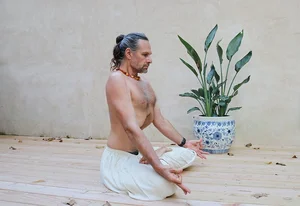
Siddhasana with Dr. M. Jayaraman
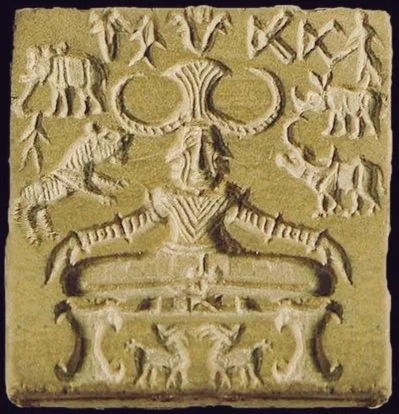
Siddhasana
Some āsanas that have been studied in this course are given more emphasis than others. Now that the teaching has reached the final four āsanas, the importance becomes especially clear. These four are regarded as very important, and they are mentioned in nearly every Haṭha Yoga text.
Aṣṭāṅga Yoga is also mentioned in some of the Haṭha texts, particularly in the Purāṇas. The notes also refer to the Paśupata seal, which is said to be roughly 4,000 years old and is considered the oldest archaeological evidence of yoga. The word paśu means “animal,” and there are animals surrounding the person depicted in Siddhāsana.
Today’s subject is Siddhāsana, specifically Siddhāsana 1. In total, five variations of Siddhāsana will be studied.
Memorization, Chanting, and Valid Knowledge
The lesson explains that smṛtyupasthāna is a word connected with memorising. Only that which is memorised and available internally is considered valid knowledge. In asaṃprajñāta samādhi, memory is said to be part of the experience. For this reason, the text is studied by chanting the words. Only after chanting the verses does the class begin the study of the word split.
Yoni and the Base of the Posture
The word yoni-sthānakam is taken up first. The word yoni can refer to the female sexual organ or womb, but it also has many meanings beyond this. In the Haṭha Yoga texts, however, yoni is generally understood as the perineum, the place between the genitals and the anus. In most Haṭha Yoga texts, this is what yoni refers to.
There is said to be a line which runs through this place, and it is used in some practices. In Siddhāsana, the heel must be firmly pressed against the perineum. Specifically, the left heel is to be used. After firmly pressing the left heel against the perineum, the right foot is placed above the penis, or above the genital organs. The text of the Haṭhayogapradīpikā specifically speaks in the male gender and uses the word “penis.”
Alignment of the Body
The spine should be straight. The word hṛdaya is mentioned. It is generally translated as “heart,” but more accurately here it can be understood as the chest, and also in relation to Anāhata-cakra. The heart, or chest, is held erect directly above the yoni.
The word hanu means “chin.” The chin must be placed on the hṛdaya. This is what is known as Jālandhara-bandha.
Stillness, Restraint, and Gaze
The body has to be still, and the word sthāṇu is used in this connection. The senses also have to be still. The indriyas must be restrained. All of the sense organs must be restrained, because in the normal state the senses pull a person in all directions, each one trying to draw attention outward.
The gaze should be steady. The eyes should be turned upward toward the center of the eyebrows. This is stated to be the posture of the accomplished yogi.
Siddhāsana and the Door to Liberation
The lesson explains the term mokṣa-kapāṭa as a closed abode in which enlightenment dwells. The door to this abode must be opened through the practice of Siddhāsana.
The essential form is restated clearly: the left heel is placed on the perineum, the right heel on top of the genitals, the limbs are held still, the sense organs are restrained, and the eyes are turned upward toward the center of the brows. The hands are not directly mentioned, but generally they are placed on the knees.
Text and Practice Together
The lesson stresses that texts cannot be studied in isolation from practice. Without practice, the practical aspects are missed. The information is codified in that sense and cannot be properly grasped without practice. Both practice and knowledge of the text are required.
Looking Ahead
Siddhāsana 2 will be taken up in the next class. It is only slightly different from the version studied here.
A Final Clarification
One question was asked: were there women doing these practices? The answer given is firmly yes. Even though the texts most often speak in the male gender, women were indeed doing these practices as well.