Alchemy of Asana
Mayūrāsana
A Living Textual Tradition
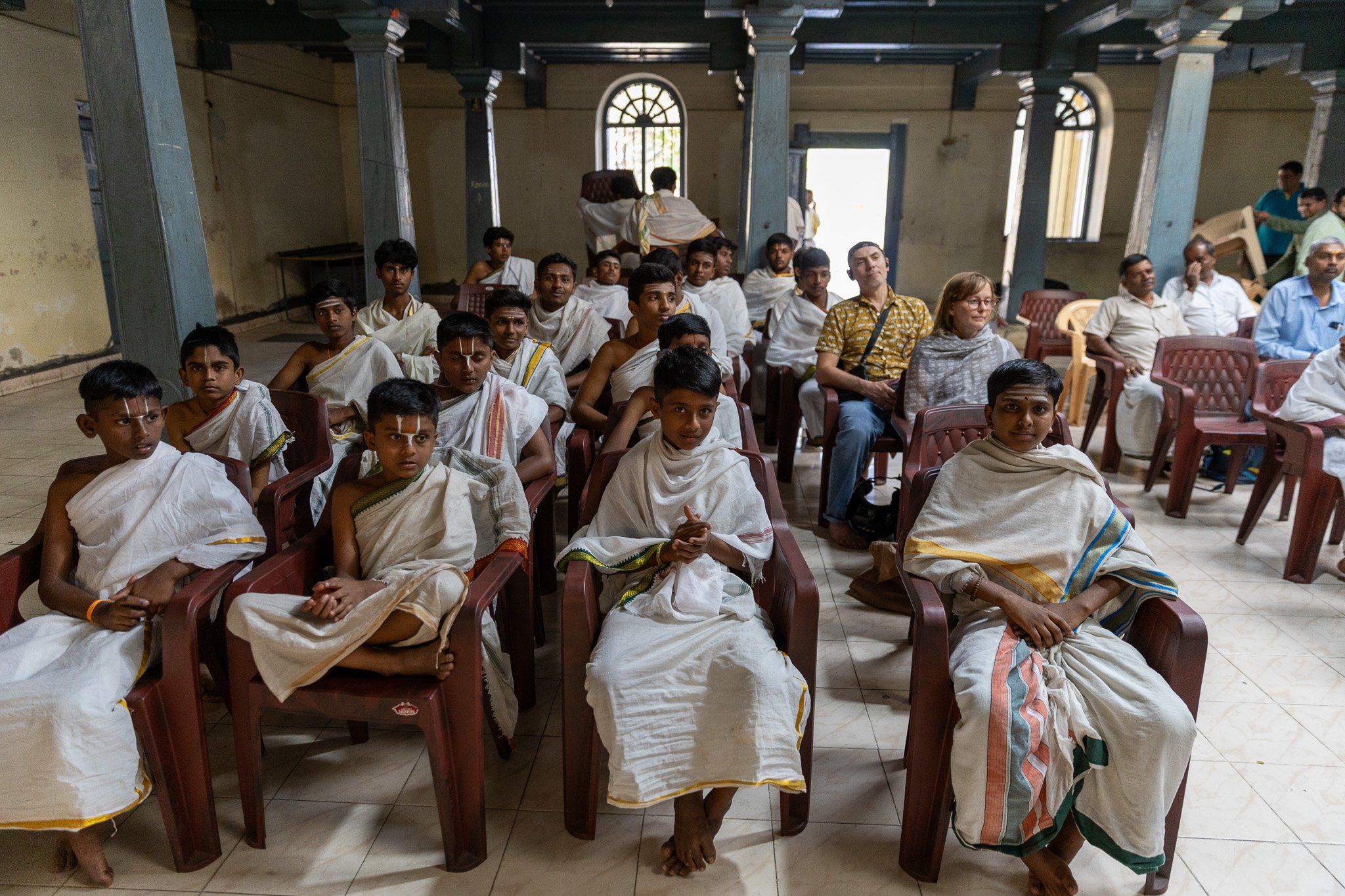
The Hathayogapradipika was composed by Svatmarama around 1550, so it is about five hundred years old. In those days it was not easy to write anything in India. Writing was done on palm leaves, and because of that the preservation of knowledge depended greatly on chanting and oral transmission. The words of the text were preserved by being recited and remembered. This is important to keep in mind when we study a work like the Haṭhayogapradīpikā. We are not simply reading an old manual of postures. We are entering into a living tradition in which sound, memory, and recitation played a central role in preserving knowledge.
The Literal Description of the Posture
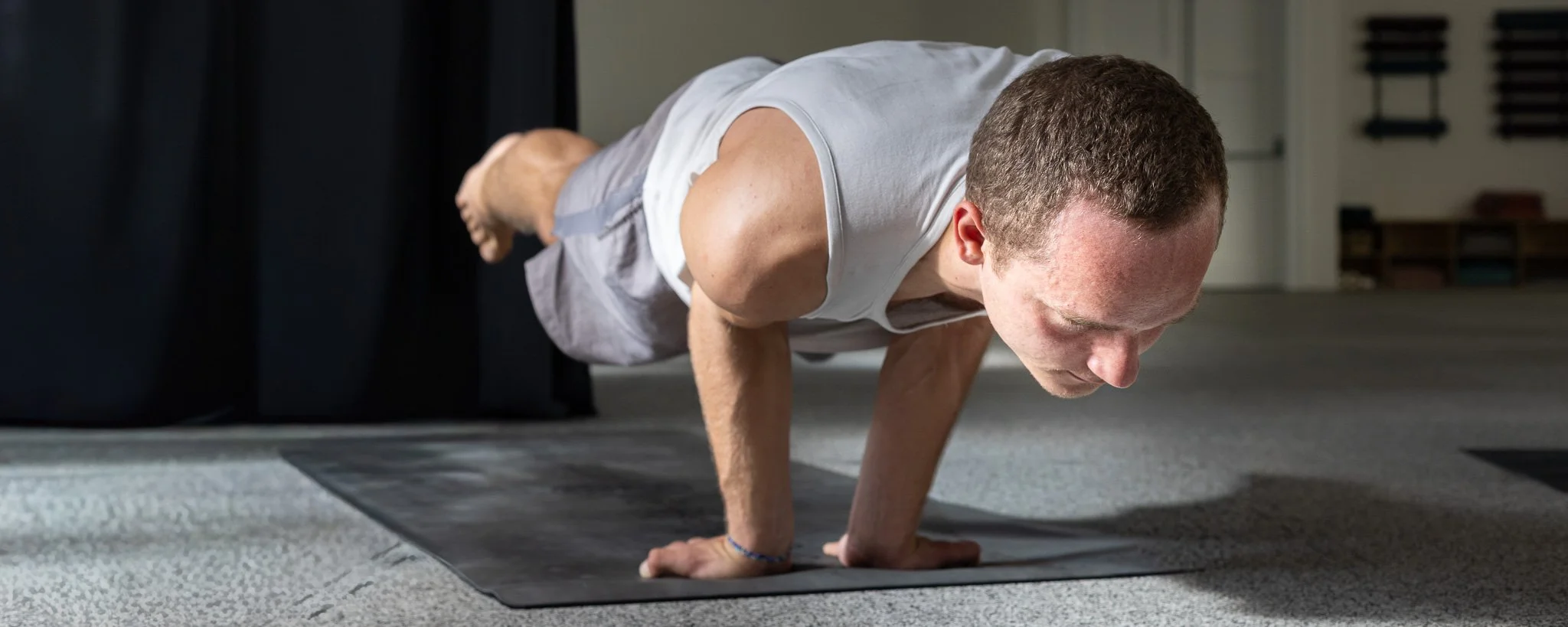
The text first describes the posture in a literal and practical way. The hands are placed together on the ground. One begins in a kneeling position and then leans forward onto the elbows. The elbows move toward the navel, one on either side.
From there, one leans onto the elbows and lifts the legs up, stiff like a stick. The body becomes firm and extended. The text also mentions prasaritāṅguli, the spreading of the fingers. The fingers should be spread, and the base of the palms should remain on the ground. The hands are to be kept together.
This gives us a very clear picture of the posture. It is a balancing āsana in which the whole body is supported through the hands and elbows, with the elbows pressing into the abdominal region and the legs extended strongly behind. It is not a loose or passive form. It requires steadiness, strength, and clear placement.
Why It Is Called Mayūrāsana
This posture resembles a peacock, which is why it is called Mayūrāsana. When the head and feet are lifted a little more, the resemblance becomes even clearer. The body takes on the shape and bearing of a peacock.
This is one of the beautiful features of the traditional names of āsanas. The name is not random. It often reflects the visual form, energetic quality, or symbolic meaning of the posture. In this case, the form of the posture itself evokes the image of the peacock.
A Revered Āsana
This āsana is described as one of the most respected āsanas. It is even called Śrī Mayūrāsana. That is significant. The peacock is one of the most respected of birds, and it is also the national bird of India. So the symbolism of the posture already carries a sense of beauty, dignity, and importance.
The peacock is also the vehicle of the deity Subrahmaṇya, whose form is associated with the serpent. Peacocks generally eat serpents and are natural enemies of serpents. So here we find something very interesting: the serpent rides the peacock. This becomes a symbol of harmony in a place where there is ordinarily enmity. As with the vehicles of all deities, the image is highly symbolic.
These ideas should not be taken in a merely literal way. They are poetic and metaphorical. Indian sacred imagery often works on this level. The forms and relationships of the deities are not there only to tell a story. They point to deeper truths about harmony, transformation, and the possibility of overcoming inner conflict.
Removal of Disease
One of the major benefits given in the text is that this āsana removes all diseases, especially diseases of the abdominal area, and that they are removed quickly. This is a strong statement and shows the very high regard in which the posture is held.
Since the elbows press into the region of the navel and abdomen, the posture is traditionally understood to have a powerful effect on this area. In the language of the text, this is not merely a strengthening posture. It is a cleansing and disease-removing posture, especially for disorders connected with the abdominal region.
Balancing the Doṣas
Another benefit mentioned is that it balances the doṣas: vāta, pitta, and kapha. This connects the posture directly with the broader framework of Āyurvedic thought. In that framework, health depends on the proper balance of these three doṣas. When they are disturbed, disease and imbalance arise.
So Mayūrāsana is presented not only as an āsana that affects muscles or joints, but as one that helps restore inner balance. This is an important reminder that the traditional yogic understanding of the body is much broader than the anatomical language most modern practitioners are used to hearing.
The balancing of the doṣas also refers to mental states. Laziness, dullness of mind, and similar conditions are also included in this field of imbalance. So when the text speaks of balancing vāta, pitta, and kapha, the meaning is not limited to purely physical conditions. Mental and emotional states are also involved.
Burning Impurities and Unsuitable Food
The text says that this practice burns to ashes unsuitable food that has been eaten. It cleans us. Even if someone has eaten huge quantities of bad or unsuitable food because of lack of self-control or other reasons, this āsana quickly burns the impurities.
This is a very striking image. The digestive fire is made strong through this practice. At first it destroys the impurities created by improper food. After that, as long as the posture is practiced regularly, it is said to protect one permanently from the effects of bad food.
This should be understood in the spirit of the text. The point is not to encourage carelessness, but to emphasize the remarkable purifying power traditionally attributed to this āsana. Mayūrāsana is portrayed as a posture of fire, purification, and resilience.
In our own time, when processed food and chemical preservatives are part of nearly all food in the world, this idea becomes especially interesting. The posture can be seen as a powerful tool for maintaining yogic health in the midst of the conditions of modern life.
Kālakūṭa and the Power to Digest Poison
The text goes even further and says that one can digest even kālakūṭa, intense poison. This term comes from the mythology of the gods and demons churning the ocean of milk. In that great myth, many extraordinary and mystical things emerge from the churning. One of them is the deadly poison called kālakūṭa and also often refered to as Halahala as in the Ashtanga Yoga chant: Samsara halahala mohashantiay.
Śiva is known as blue-throated because of this poison, and of course the peacock too is marked by blue coloring. Here again, the symbolic dimension is important. The deadly poison is not only something mythological. It can also be understood metaphorically as our own fears, inner demons, depression, and mental imbalances.
So when the text says that Mayūrāsana can digest poison, the statement has a wider meaning. The posture is being presented as a force of transformation. It is not only about digestion in the narrow physical sense. It also points toward the possibility of processing and overcoming what is toxic within us.
Digestion, Immunity, and the Mind
Modern knowledge gives us another interesting perspective here. Gut health and the biome have been shown to have a major effect on the mind, the immune system, and digestion itself. This does not replace the traditional teaching, but it gives us an interesting middle ground from which to think.
The older texts speak in the language of agni, doṣas, and purification. Modern science speaks in terms of the gut, the microbiome, immune response, and nervous system regulation. These are different ways of describing the body, but there is a very interesting place where they begin to speak to one another.
This is worth reflecting on, because the anatomical and science-based ideas used by most yoga teachers in the West are quite different from the kind of knowledge and perspective given by the Haṭhayogapradīpikā and related texts. Science is not wrong, of course. But Indian thought and the ancient yoga texts offer a deeper dimension that takes much study to articulate clearly.
Invigoration of Body and Mind
Mayūrāsana invigorates not only the body but also the mind. This is an important point. The balancing of the doṣas, the strengthening of digestive fire, and the removal of dullness all suggest that the posture has a strongly awakening quality.
When we are absorbed in screens, tired, dull, and drained from inactivity, these teachings become especially relevant. This āsana is presented as something that counters heaviness, stagnation, and depletion. It restores alertness and vitality. In that sense, it is not only therapeutic for the body, but refreshing for the mind as well.
Preparing for Higher Practice
Siddhāsana is said to be the best of all āsanas. Postures like Mayūrāsana are key to reaching that place where one can sit in Siddhāsana and explore the inner teachings of yoga.
This is a very important reminder of the larger purpose of āsana in Haṭha Yoga. The aim is not simply the performance of difficult postures. More demanding āsanas help purify, strengthen, and prepare the practitioner. They make the body and mind fit for the deeper inward work of yoga. In that way, a posture such as Mayūrāsana supports the higher goal rather than standing as an end in itself.
A Meeting Point Between Ancient and Modern Perspectives
One of the most interesting points raised here is the contrast between the anatomical science-based ideas used by most yoga teachers in the West and the kind of knowledge found in the Haṭhayogapradīpikā and other traditional texts. These are quite different perspectives.
Modern anatomical explanations often focus on muscles, joints, strength, compression, and balance. The traditional texts speak instead of prāṇa, doṣas, agni, purification, poison, and subtle effects on mind and health. Both ways of looking have value, but they are not the same.
There is a very interesting middle ground here. Science gives one kind of clarity, but the Indian yogic tradition gives another layer of meaning that is deeper and broader. It includes symbolic, energetic, psychological, and spiritual dimensions that cannot easily be reduced to anatomy alone. To articulate that well takes a great deal of study.
Conclusion
Mayūrāsana is presented as a powerful and highly respected āsana. Its form is precise: the hands are together on the ground, the fingers are spread, the base of the palms is rooted, the elbows come to either side of the navel, and the legs are lifted stiff like a stick. The shape resembles a peacock, especially when the head and feet are lifted more fully.
Its benefits are described in striking terms. It removes disease, especially in the abdominal region. It balances vāta, pitta, and kapha. It burns the impurities of unsuitable food, strengthens the digestive fire, and is even said to digest poison. It invigorates both body and mind.
At the same time, the symbolism surrounding the peacock and the mythology of kālakūṭa remind us that these teachings are not only literal. They point to a deeper process of purification and transformation. Mayūrāsana becomes not only a posture of physical strength, but also a practice of inner cleansing and renewal.
In this way, the āsana stands as a bridge between body and mind, between health and symbolism, and between the older language of Haṭha Yoga and the questions of modern life.
If you enjoy this kind of information please explore the Mysore Yoga Traditions Online Studies Program! We have a wide selection of live and prerecorded courses with the highest quality of information from Mysore’s Sanskrit community.