Sankhya
Karika
The philosophy of yoga, verse by verse with Dr. H. V. Nagaraj Rao
The theory behind the practice
Every practitioner of yoga eventually meets Sankhya, the ancient Indian system that provides the conceptual architecture for the Yoga Sūtras, the Bhagavad Gita, and much of the wider tradition. Its vocabulary runs through everything: puruṣa and prakṛti (consciousness and nature), the three guṇas (nature’s three forces), buddhi and ahaṃkāra (intellect and the sense of “I”), the five tanmātras (subtle essences behind the elements). When Patañjali describes the nature of the mind, or Kṛṣṇa explains liberation, they are drawing on a framework Sankhya built.
Sankhya and Yoga are two sides of one coin. Sankhya is the theory: a complete, rational account of what reality is, how suffering arises, and what liberation means. Yoga is its practical application. You cannot fully understand one without the other.
Studying Sankhya does not add something new to your practice. It reveals the structure of what was already there. This course lays that foundation, taught verse by verse through the Sankhya Kārikā of Īśvarakṛṣṇa, the classical text of the tradition, by a scholar who has spent a lifetime inside the philosophical world these verses inhabit.
दृष्टे सापार्था चेन्नैकान्तात्यन्ततोऽभावात् ॥ १ ॥
Prompted by the anguish of the threefold suffering, the inquiry arises into the means of its removal. If it is said the visible means suffice, no, for they lack both certainty and finality.
What Sankhya actually teaches
The word Sankhya means enumeration, a precise and systematic account of reality. The tradition identifies 25 fundamental principles (tattvas) that together account for everything that exists: twenty-four evolving from original undifferentiated matter (prakṛti) through intellect, ego, mind, senses, and elements, and one eternal, unchanging witness (puruṣa) that stands apart from them all.
Suffering arises from the confusion of puruṣa (the witnessing soul) with prakṛti (ever-changing nature, governed by the three guṇas). Liberation comes from discriminating clearly between the two.
Twenty-five principles, twenty-four evolving from prakṛti and one eternal witness, together with three reliable means of knowledge: perception, inference, and trustworthy testimony. A precise anatomy of mind, senses, and vital energies, all oriented toward self-realization.
Each individual soul is many and eternal, carrying a subtle body with karmic tendencies across lifetimes, yet remaining untouched and free at its core. The soul is the silent witness, never the actor.
Liberation begins with training buddhi (intellect) to turn inward and detach from the play of the guṇas, resting in the silent clarity of puruṣa: liberation through discrimination alone.
Sankhya is wholly rational and logical. There is no mention of any deity. It simply lays out a precise worldview that lets the practitioner understand the nature of experience and transcend unnecessary suffering. It is, in the deepest sense, the philosophy of yoga.
कैवल्यं माध्यस्थ्यं द्रष्टृत्वमकर्तृभावश्च ॥ १९ ॥
From puruṣa’s being the contrary of prakṛti, it is established: puruṣa is witness, isolated, indifferent, pure seer, and utterly inactive.
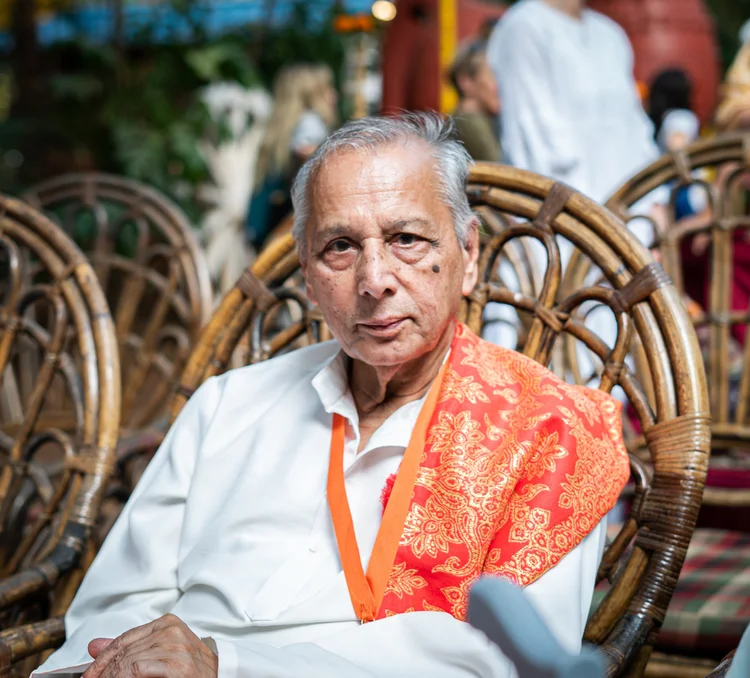
Dr. Rao’s specialty is Vyākaraṇa and Alaṅkāra, Sanskrit grammar and poetics, so he can speak with precision about exactly what is meant by any Sanskrit text. In a lifetime of scholarship he has published original Sanskrit works with English and Kannada translations, and lectured across four continents.
What students remember is his gift for making technically dense philosophical texts clear, precise, and warm. People who have spent years reading about Sankhya often say its concepts came into focus for the first time under his teaching. After a lifetime of scholarship spanning four continents, he continues to share the living tradition of Mysore Sanskrit learning with students from around the world.
Dr. Rao carries the living Sanskrit tradition of Mysore, the cultural ground from which modern yoga went out to the world. His Sankhya is the understanding of a scholar formed within the very tradition these texts belong to, in a line of learning that reaches back many centuries.
What the course covers
The course works through the Sankhya Kārikā of Īśvarakṛṣṇa, the foundational text of classical Sankhya, composed in some seventy concise verses. Dr. Rao takes each verse carefully, explaining its Sanskrit terminology, its philosophical argument, and its relevance to yoga practice and daily life.
Name and explain Sankhya’s 25 core principles (tattvas) in plain language, from prakṛti through its twenty-four evolutes to the eternal witness, puruṣa.
Understand how the three guṇas (sattva, rajas, and tamas) shape every aspect of experience, and learn to work with them purposefully.
Distinguish the witness (puruṣa) from the constantly changing activity of mind, body, and experience, the central discriminative insight Sankhya cultivates.
Gain a foundational understanding that directly illuminates the Yoga Sūtras, the Bhagavad Gita, and most other classical Indian texts: Sankhya is the shared vocabulary of the tradition.
What is included
Complete verse-by-verse recordings with Dr. Rao. Stream on any device, revisit anytime.
Every session as audio only. Sankhya is well suited to contemplative listening.
A written summary of each lesson to read before or after watching.
A downloadable copy of the original Sankhya Kārikā for reference throughout your study.
A 30-minute session with Andrew Eppler to clarify concepts or integrate them into your practice, included in the price.
Your course never expires. Sankhya deepens with return visits as your practice matures.
Certificate of completion issued by Samskriti Foundation, Mysore.
Recognized as Continuing Education for Yoga Alliance registered teachers.
Who this course is for
This course is for anyone who wants to understand the philosophical foundations of yoga more deeply. You do not need to read Sanskrit. You do not need any background in Indian philosophy. The course is designed to be entered from wherever you are.
It is well suited to yoga teachers and practitioners who find the Yoga Sūtras or Bhagavad Gita fascinating but feel they are missing the conceptual vocabulary to fully grasp them. Sankhya is that vocabulary, and once you have it, much else becomes clearer.
It is also a good course for meditators seeking a rational map of mind and liberation, and for therapists or coaches drawn to India’s ancient understanding of consciousness and suffering.
No prior Sanskrit or philosophy is required. What is required is curiosity and the willingness to think carefully about the nature of experience.
Sankhya and the Mysore tradition
The yoga that went out from Mysore to the world rests on the full breadth of Indian philosophical learning, and Sankhya sits close to its center. The Yoga Sūtras themselves presuppose Sankhya’s framework: Patañjali’s puruṣa, prakṛti, guṇas, and citta (consciousness, nature, the three forces, and the mind) are all Sankhya categories, taken up within a discipline of practice.
To study Sankhya with Dr. Rao is to meet these ideas as the tradition itself holds them, not as museum pieces but as a working map of the mind and the way to freedom. He carries the living Sanskrit learning of Mysore, the cultural ground from which modern yoga came.
What students say
Some of the most interesting and insightful teaching I have experienced. Andrew Eppler has deep connections with the established Mysore scholars. The teachings are rich and varied. From his own training to online courses with Śrī Alwar to actual immersions in Melkote, this is an experience that will change you. Deepest thanks to you, Andrew Ji.
Dava Caldwell · Toronto, CanadaThe journey you’ve created is unique in its depth. Giving space to the people of bhārata and blended with your commitment and years of yoga mārga is priceless. I am grateful to have met such a committed group of people, and our departure at Melkote left a beautiful imprint in my heart.
Santiago · Barcelona, SpainThe Sankhya Kārikā, the Yoga Sūtras of Patañjali, and the Bhagavad Gita form the three courses of the Yoga Trilogy, the philosophical and practical foundations of yoga as Mysore’s tradition has always taught them. Sankhya is the ground. The Sūtras are its practice. The Gita is its living expression. Studied together, they become something rare: a complete philosophical education in the tradition that gave modern yoga to the world. All three courses include video, audio, and written notes, with permanent access.
Three individual courses. Save $66 by studying the complete Yoga Trilogy together. Explore the Trilogy →Enroll today
Start learning immediately. Your course never expires.
If the course fee presents a real difficulty, please reach out. We will find a way.
Enroll now → Instant access · No subscription · Your access never expiresQuestions first? Reach out directly. I’m happy to help.
Andrew Eppler · andrew@ashtangayogastudio.com
WhatsApp +1 (405) 503-7779
